For a decade, prediction markets have asked the world’s least interesting question: yes or no.
The real economy runs on numbers, not coin flips: a price, a difficulty, a revenue per hash.
Glimpse is the first market built for those numbers, priced and settled in Bitcoin, and its newest traders are not people at all. We gave one of them 5,000 sats and walked the whole platform. Here is what we found.
Glimpse in brief: a range of numbers, not a yes or no
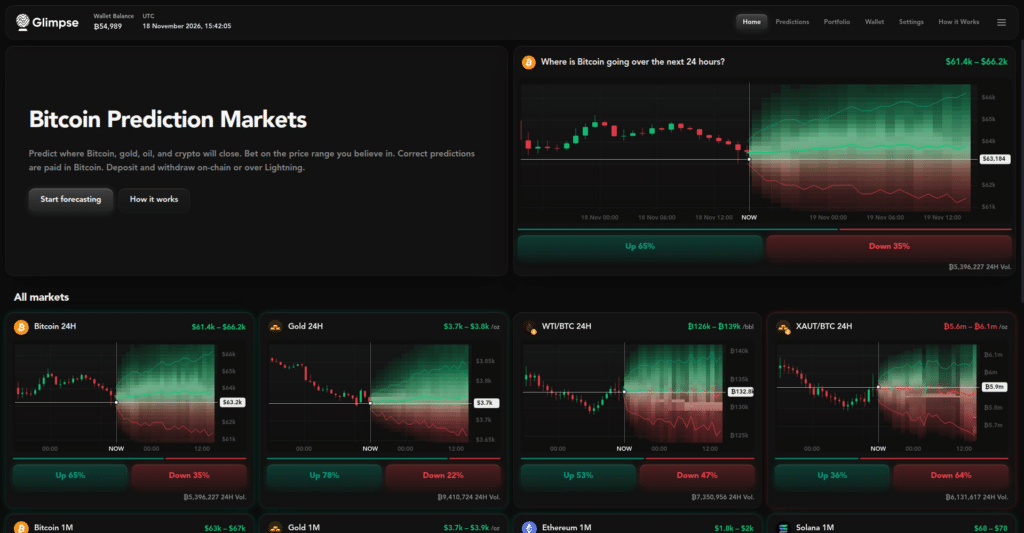
Every prediction market you know asks a yes or no question. Glimpse asks a number. 
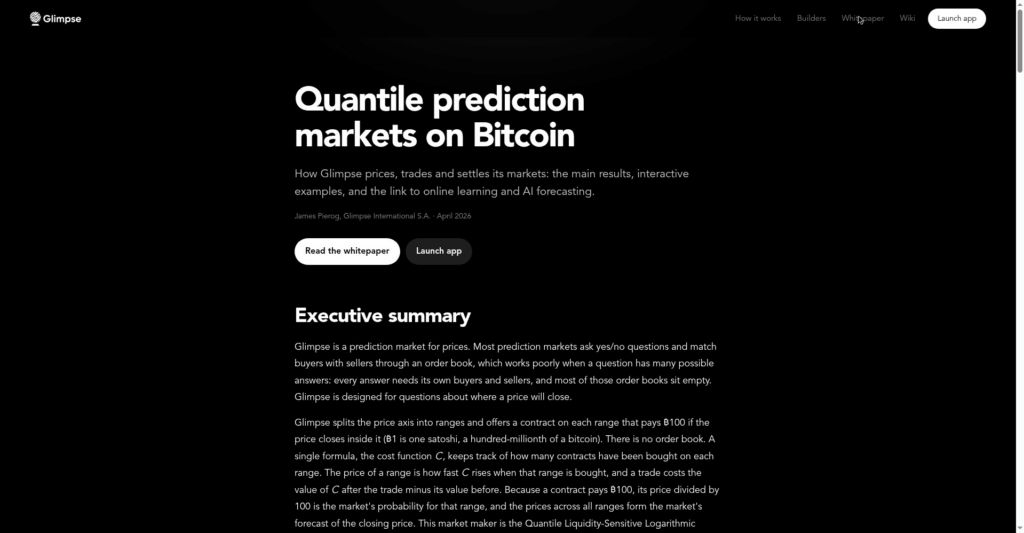
Instead of betting on whether Bitcoin closes above a line, you buy the price range you think Bitcoin will close inside. Each range is a contract that pays out 100 sats if the price lands there and zero if it does not. The price of each contract, divided by 100, is the market’s probability for that range, so the full set of prices forms a live probability distribution over the closing price. The odds are the forecast.
It is priced, settled and paid entirely in Bitcoin, over Lightning. We opened an account, deposited 5,000 sats, handed the trading to our AI for 40 straight hourly bets, and walked every screen of the app. This is what we found.
What Glimpse is
Glimpse runs 11 markets on where a number will land: Bitcoin hourly and daily, gold hourly and daily, gold priced in sats, Ethereum daily, Solana daily, oil priced in Bitcoin, and a mining trio built for the people who live with difficulty adjustments every two weeks: Network Difficulty, Difficulty Adjustment, and Hashprice Daily, a market on the miner’s revenue per unit of hashrate. Together the mining markets give miners something no event market offers: a hedge, priced in Bitcoin, on the numbers their income is made of.
There is no order book. A single automated market maker, a quantile variant of the LMSR formula described in Glimpse’s whitepaper, quotes every range at all times, and Glimpse funds each market up front, which caps its own maximum loss. Contracts are fractional, priced between 0 and 100 sats, and fully collateralised: you pay upfront, so the most you can lose on a position is what you paid.
The operator is Glimpse International S.A., incorporated in Panama. The service is not available to residents of the United States, Canada or the United Kingdom.
Getting started: account, deposit, first trade
Sign-up took one click with Continue with Google. There is no identity verification to open and fund an account; the privacy notice states Glimpse does not collect identity documents. Two-factor authentication is optional for trading but required before you can withdraw, which is the right way round.
We funded the account from a Spark Lightning wallet. The 5,000-sat deposit cost 22 sats in routing and fees on top and showed in the Glimpse wallet within minutes, with the deposit listed in the transaction history.

Then we did the part no review we could find had done: we let an AI trade it. First, though, a full tour of the app, screen by screen, so you can see exactly what you are signing up for.
Full walkthrough: every screen
Eleven markets, one list
The home screen is a list of live markets, grouped by asset and timeframe. Bitcoin leads, in hourly and daily form. Around it: gold in hourly and daily form, gold priced in sats (a market we have not seen anywhere else, and a quiet statement of who this platform is for), Ethereum, Solana, oil priced in Bitcoin, and the mining trio of Network Difficulty, Difficulty Adjustment and Hashprice Daily. Eleven markets in total. Each row shows the market, its close time and its current pricing at a glance, and one click takes you into the market itself. The header also carries a Fear and Greed reading (25, Extreme Fear, on the day of our final capture): an indicator, not a market, whatever you may have read elsewhere. There is no clutter and no casino furniture: no slot-machine banners, no bonus wheels, no deposit-match confetti. It reads like a trading terminal that happens to be denominated in sats.
Hourly Bitcoin: every range has a price
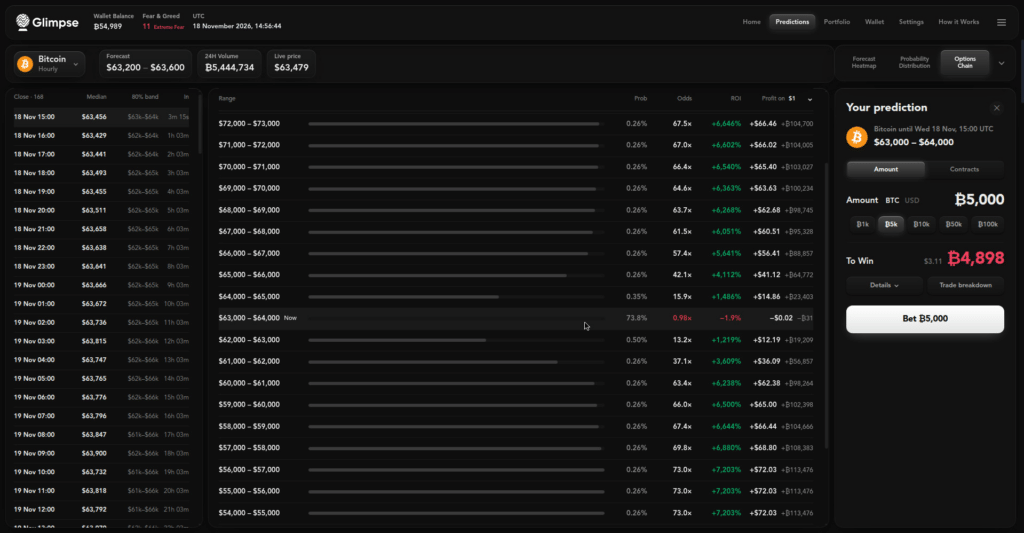
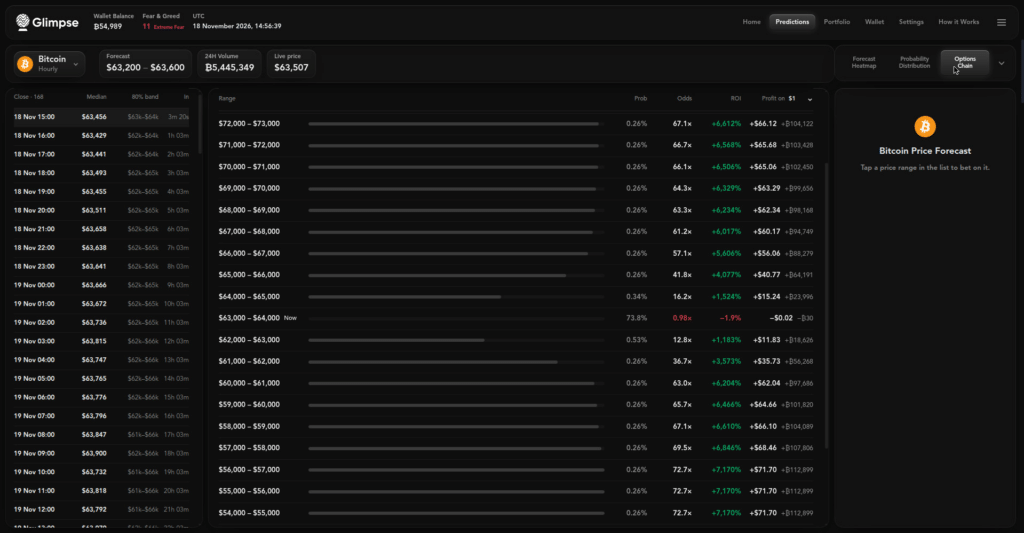
This is the screen you will live on. At the top, a price chart tracks Bitcoin against the ranges on offer. Below it sits the ladder: the plausible closing zone tiled into ranges, 200 dollars wide on the hourly market, each with a price between 0 and 100 sats. That price is the whole idea in one number. A range priced at 35 sats is the market saying the close lands there with about 35 percent probability, and if it does, the contract pays 100 sats. Read down the ladder and you are reading a probability distribution, drawn live by everyone trading against the market maker.
The ranges near the current spot price carry the highest prices, as they should. The tails are cheap, a few sats each, and they are where the market confesses how much it fears a violent move in the next hour. Watching the ladder reshape itself around news is the most interesting spectator sport in Bitcoin right now, and it is free.

The trade panel: stake, contracts, payout preview
Click a range and the trade panel asks one question: how many sats? Type an amount and it shows the rest before you commit: how many contracts that buys (fractional contracts are normal here, our trades ranged from a fifth of a contract to just over ten), the price per contract, the potential payout, and the multiple, shown as a “To Win” figure and odds. Our previews ranged from a sober 2.04x on a range the market liked to 5.60x on one it did not.
Two honest observations from 40 live trades. First, the preview is a quote, not a promise: at larger sizes the executed cost came in above the preview (a 200-sat preview executed at 232 sats once, and at 212 another time), while at small sizes it sometimes executed a few sats under. Second, the fee is inside the number you see: the 2 percent buy fee is taken as part of the trade, so the cost in your portfolio is the cost, with nothing added later. Confirming is one click, and the position appears in the portfolio immediately.
Daily Bitcoin: the same machine on a longer fuse
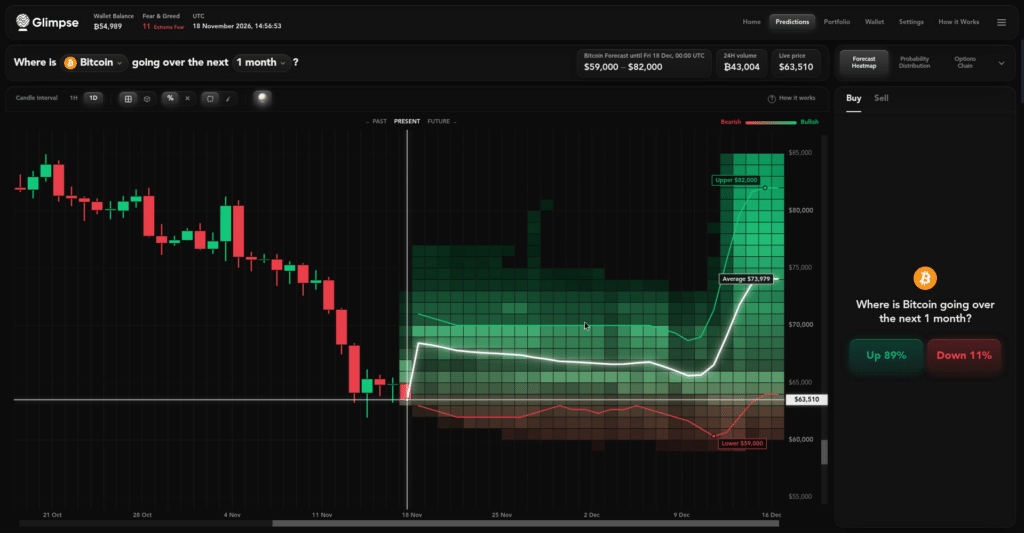
The daily market is the same machine on a longer fuse: it closes at 00:00 UTC and settles on the Binance BTC/USD price at that moment. The ladder covers the day’s plausible zone, and because a day admits more outcomes than an hour, the distribution is wider and the prices flatter. This is the market to watch if you want Glimpse’s core claim tested: given a full day of trading, does the crowd’s distribution beat a model’s? We audited the record ourselves: 85 daily Bitcoin markets resolved between August and November 2026 are published with their winning ranges, free for anyone to score. Few young platforms hand you their track record in machine-readable form. This one does, and the walkthrough later in this review shows where to find the numbers.
Network difficulty: the market nobody else runs
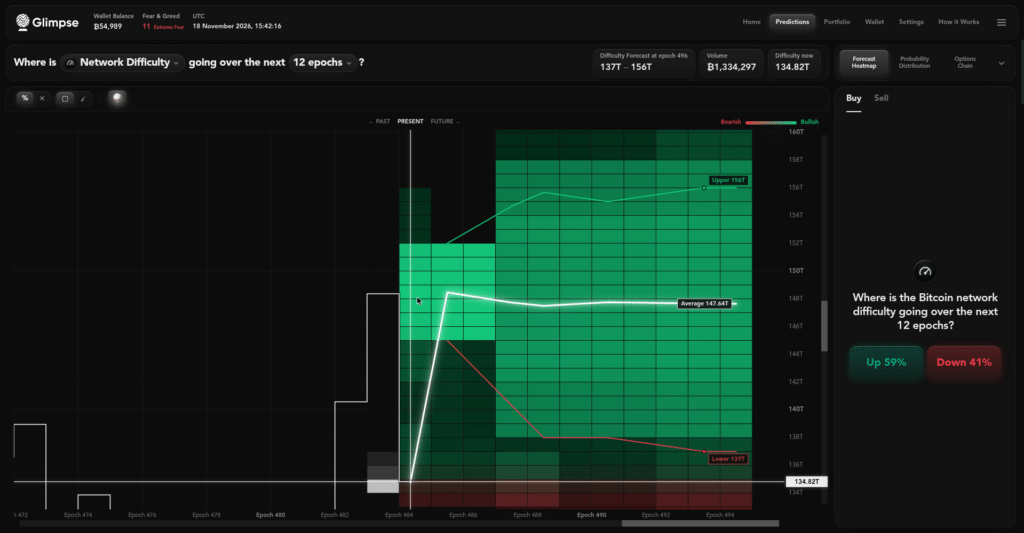
The market no other prediction platform runs: where Bitcoin mining difficulty lands at the next adjustment. Miners’ revenue is difficulty divided into the block subsidy and fees, so difficulty is half of every miner’s income statement, and until now there was no clean way to trade a view on it, let alone hedge it, in Bitcoin. The difficulty market works exactly like the price markets: a ladder of ranges, prices as probabilities, 100 sats to the winning range. When we captured it on 7 November the network sat in epoch 484 at 148.36 trillion, with a forecast spanning 50 to 250 trillion by the next retarget.
Difficulty adjustment and hashprice: the miners’ markets
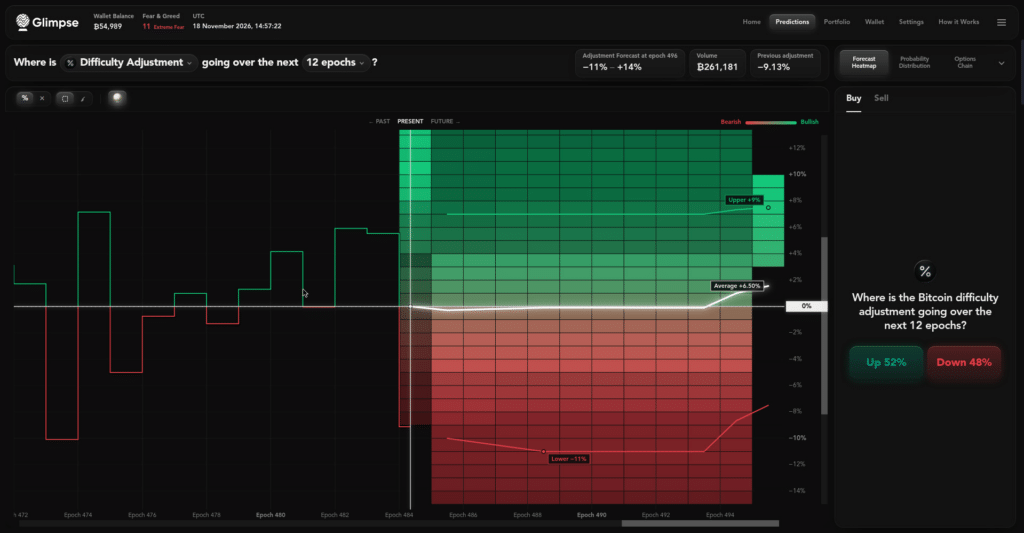
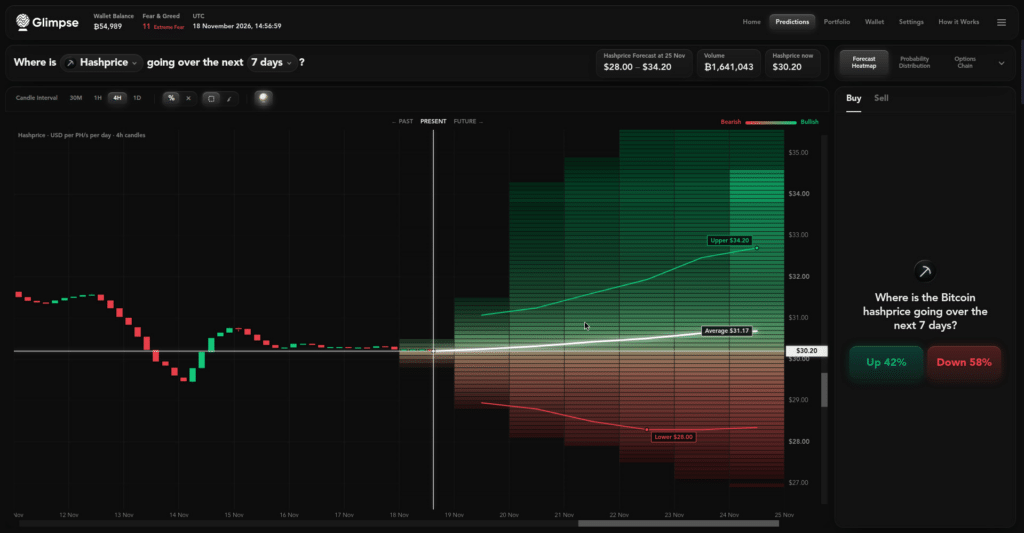
Difficulty gets a second market: the adjustment itself, traded as the percentage change at the next retarget. On capture day the running estimate stood at minus 4.10 percent and the forecast band ran from minus 7 to plus 6 percent, a range that narrows as the epoch’s 2,016 blocks fill in and the arithmetic locks. The third mining market completes the set: Hashprice Daily, a market on the dollar value of one petahash per second for a day, the number every mining P&L is built from. It printed 32.38 dollars at capture, with a forecast band of 31.80 to 33.00 dollars. Difficulty on one side, the value of hashrate on the other, both settling in sats: if you mine, these three pages alone justify an account, even a small one. We have written separate how-to guides for the hashprice and difficulty adjustment markets, linked from this review’s companion coverage.
Gold, oil, Ether, Solana: the supporting cast
Gold is the second citizen here, in hourly and daily form, including the version priced in sats (listed as XAUT/BTC), which quietly asks the best question in hard money: not what gold costs in dollars, but what it costs in Bitcoin. At capture it took about 5.34 million sats to buy an ounce. Ethereum and Solana run as daily markets, and oil is priced in Bitcoin rather than dollars (WTI/BTC, about 119,000 sats a barrel at capture), which makes every one of these markets a relative-value trade against Bitcoin itself, whether the trader notices or not. Every one of them settles in sats over the same machinery.
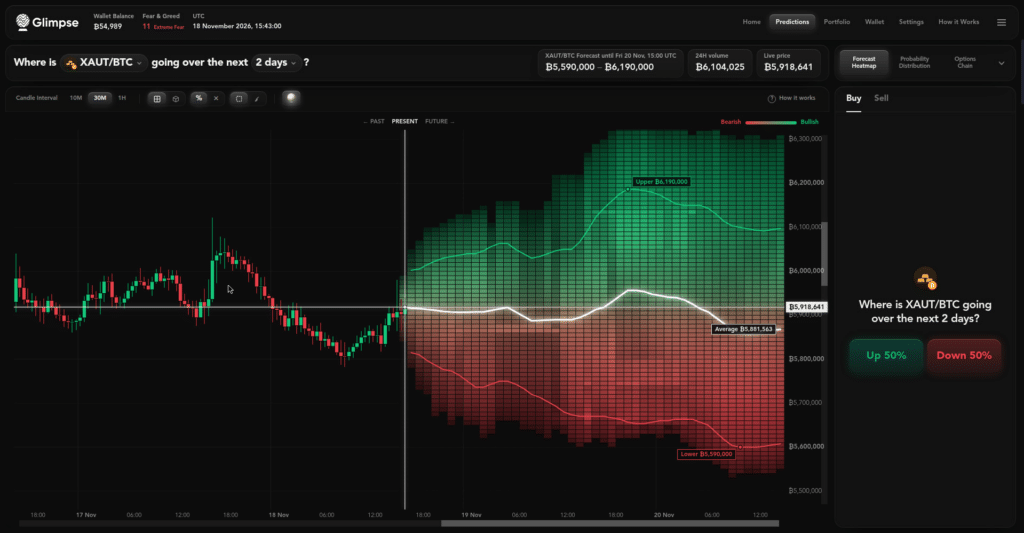
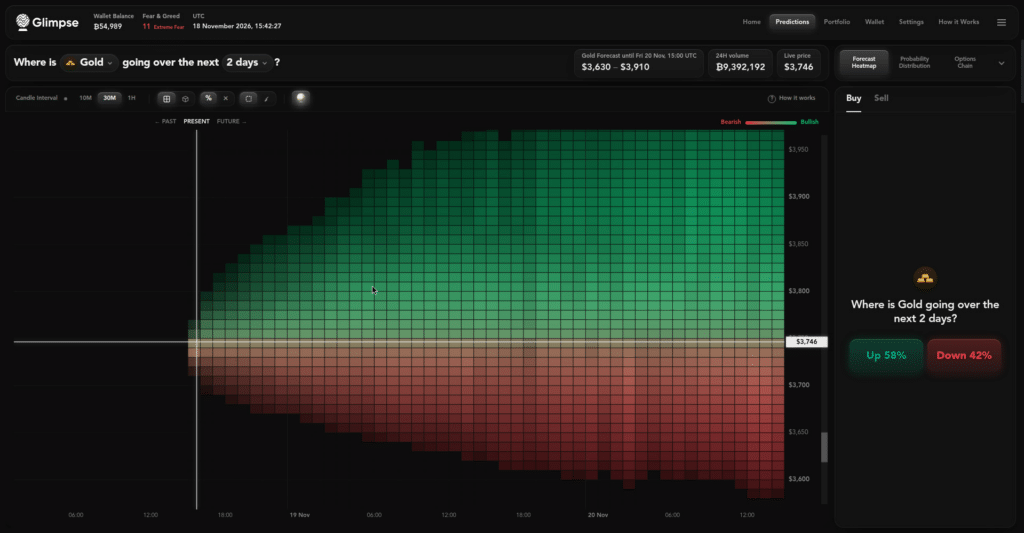

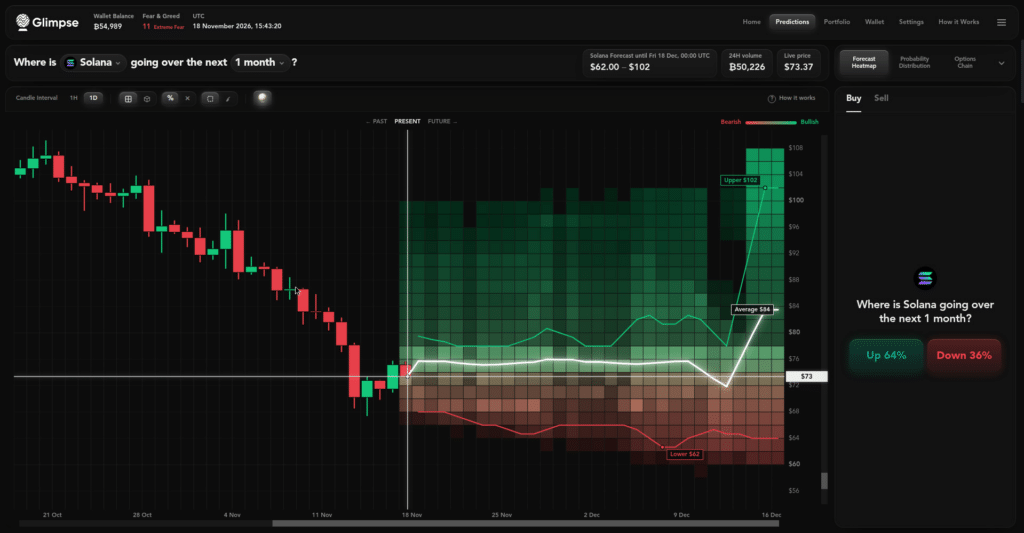
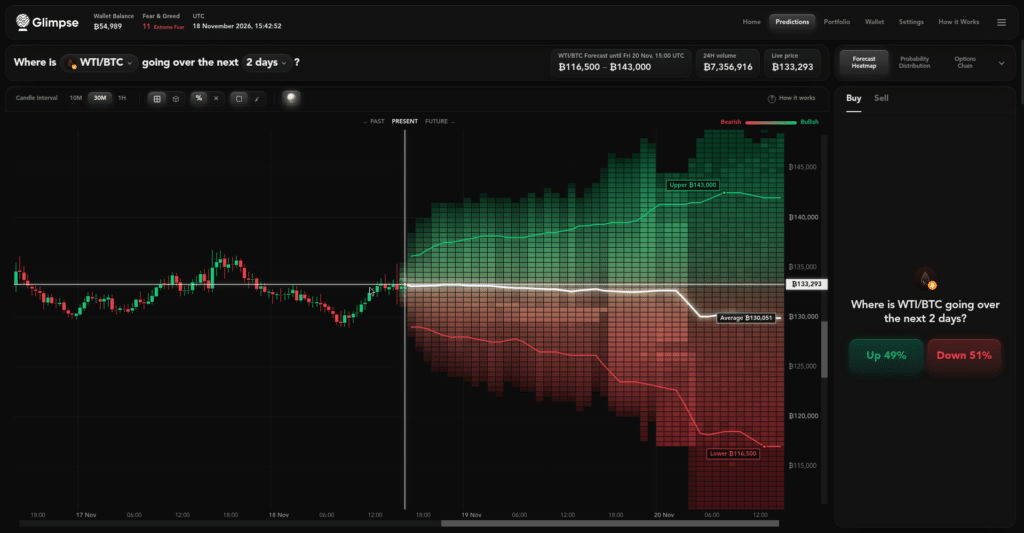
The daily versions reward a closer look. Gold Daily at capture, with spot at 4,061 dollars, carried a forecast band of 4,030 to 4,075 dollars for the next close: a tight, confident distribution around a quiet metal. Ethereum Daily, spot 2,243 dollars, spread its band from 2,130 to 2,460, and Solana Daily, spot 90 dollars, from 84 to 96, both visibly wider in percentage terms than anything Bitcoin or gold was offered at, which is the crowd pricing altcoin volatility honestly rather than copying Bitcoin’s shape. Even the oil market’s band, 118,500 to 120,000 sats around a 119,418-sat spot, reads as a statement about Bitcoin as much as about crude. Read across the whole board and the platform becomes a single instrument: eleven distributions, all denominated in the same unit, each one a priced opinion about where a number lands next.
Portfolio: live positions, marked to market
The portfolio screen is where positions sit while their markets run. Each live row shows the market, the range you hold, what you paid, what the position is worth right now, and the profit or loss if you sold at this moment, because positions can be sold back to the market maker before the close, at a 2 percent sell fee, rather than held to settlement. Watching a position breathe as spot crosses in and out of your range is instructive and slightly addictive. One reviewer-grade detail: the live value and the arithmetic do not always agree to the last sat. We repeatedly saw profit figures one sat away from payout minus cost, a rounding artifact in the display. It never changed what we were actually credited, but a platform asking to be trusted with probabilities should expect to be checked on its arithmetic, and now it has been.

Portfolio history: the audit trail
Settled positions move to history, and this screen is the audit trail: every market, the range held, the cost, the payout, and the result. It is also, occasionally, a lesson in reading a young platform’s displays carefully. The wallet history sometimes labels a payout with the hour after the market it belongs to, and headline portfolio totals once showed us 42 trades against the 40 we had actually placed. The underlying record, the one our sats followed, was always right: every settlement we were owed arrived, to within the one-sat display rounding noted above. We verified that against our own independent log of all 40 bets, kept outside Glimpse, line by line.

The wallet: balance and history in sats
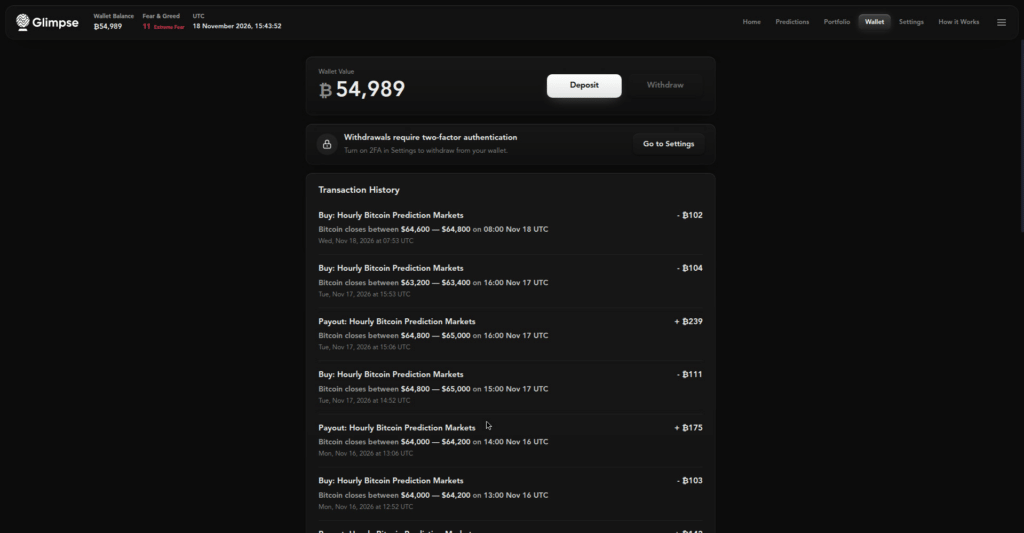
The wallet screen shows your balance in sats, your deposit and withdrawal routes, and the transaction history: deposits, buys, sells and payouts, each with its time. Our balance across the experiment, from the 5,000-sat deposit through 40 bets, reconciled with our external log at every check we ran, including after the wallet page itself twice showed a stale or empty history while the header balance stayed correct. Trust the balance and the settlement record; treat any single panel as a view, not the ledger.
Depositing: Lightning only
Depositing is Lightning-native: the wallet offers a Lightning deposit, the app presents an invoice, you pay it from any Lightning wallet, and the funds land in the account. Our 5,000 sats came from a Spark wallet, cost 22 sats in fees on the sending side, and were spendable within minutes. There is no card rail, no bank transfer dance and no waiting period, which also means there is no chargeback safety net: sats sent are sats sent.

Withdrawing: gated by two-factor
Withdrawal is the mirror image, with one deliberate piece of friction: you must enable two-factor authentication before the app will let you withdraw. We approve of the order of operations. Trading is low-risk to your account’s security in a way withdrawal is not, and gating the exit behind 2FA is the correct default for a custodial balance. Keep that word in mind, custodial: until you withdraw, your sats are a balance on Glimpse’s books, not coins in your wallet. That is true of every account-based exchange and market, and the honest way to use any of them is to keep working balances small and sweep winnings out.
Settings: email, units, security
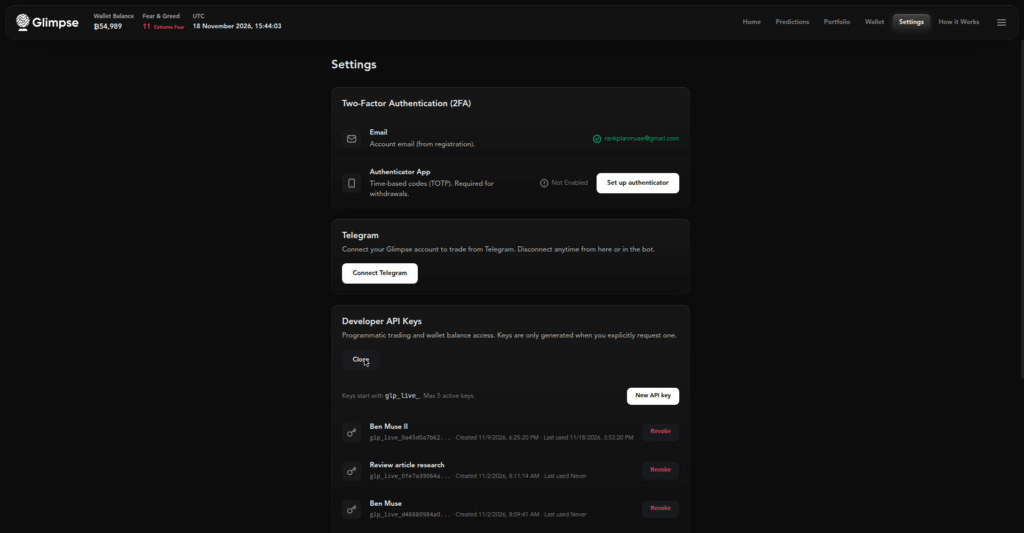
Settings is short: your email, shown verified in our case after the Google sign-in, the 2FA control, and the API keys section. Nothing here tries to upsell you. The account felt, throughout, like a tool built by people who expect their users to be adults: no dark patterns, no retention mazes, no notifications begging for attention.

API keys: up to five, shown once
Glimpse lets you hold up to five API keys, each shown in full only once, at creation. The keys are where the platform’s machine-first design shows: the same account you trade by hand can be traded by a bot, against a documented REST API, with an official Python client. Our own experience with the key flow is in the API section below, including the part that did not work.
The whitepaper: how the prices are made
Most prediction markets ask you to trust the house’s description of its market maker. Glimpse publishes the maths. The whitepaper sets out the quantile LMSR design, why an order book fails when one question has hundreds of outcomes, how the operator’s upfront funding caps its own maximum loss, and why the prices can be read as a probability distribution rather than a bookmaker’s opinion. You do not need to follow every line of the maths for it to matter: it means the rules of the game are inspectable before you stake a sat, which is more than the incumbents offer.
The experiment: an AI betting on Bitcoin every hour
Our AI, Ben Muse, trades under fixed rules. One bet per hourly Bitcoin market. Buy only the range that contains the current spot price. Log every decision, fill and settlement to a public audit file, wins and losses alike. The first live bet, placed about 35 minutes before the 20:00 UTC close on 2 November 2026:
| Detail | Value |
|---|---|
| Market | Bitcoin Hourly, BTC/USD |
| Range bought | $76,800 to $77,000 (spot was $76,850 to $76,900) |
| Contracts | 2, at 48.5 sats each |
| Total cost | 97 sats, including the 2% fee |
| Payout if the range wins | 200 sats |
| Balance after | 4,902 sats |
After the first bet we cut the stake to about 10 sats an hour, because a test should be cheap. Then we did what reviewers do: we kept going. The run grew in two rounds over two days.
Round 1 was 20 hourly bets: the first at 97 sats, nine at about 10 sats, seven at 20 sats, and the last three at 200 sats each when we wanted to see how the market maker handled real size. It finished 13 wins and 7 losses, 928 sats staked, 996 sats paid back, net plus 68 sats, and the account stood at 5,066 sats. A bot, a naive rule and a small profit: the worst possible outcome for honest analysis, because it tempts everyone to believe the rule works.
Round 2 was the cold water. Twenty more bets, each entered at 180 sats after the first one taught us that a 200-sat preview can execute at 232, so the entered amount was cut to keep the real cost under a hard cap. The rule did not change. The market did, or the luck did: four bets were lost to an overnight outage (the hours passed, the markets closed, no bet was placed, and those hours are simply missing from the record), one market accidentally received two bets when a check raced a placement, and the first 19 settled bets came in at 9 wins and 10 losses, 3,490 sats staked, 3,311 sats back, net minus 179 sats. The 40th and final bet, 180 sats on the $80,000 to $80,200 range closing at 21:00 UTC on 4 November, then landed the round’s biggest single win: Bitcoin closed at $80,126, inside the range, and the position paid 626 sats for a profit of 446. Round 2 closed at 10 wins and 10 losses, 3,670 sats staked, 3,937 back, net plus 267, and the account ended the experiment at 5,333 sats.
| Round 1 | Round 2 | Combined | |
|---|---|---|---|
| Bets | 20 | 20 | 40 |
| Wins / losses | 13 / 7 | 10 / 10 | 23 / 17 |
| Staked | 928 sats | 3,670 sats | 4,598 sats |
| Paid out | 996 sats | 3,937 sats | 4,933 sats |
| Net | +68 sats | +267 sats | +335 sats |
Three lessons survived both rounds. First, the spot-range rule is not an edge, whatever the final scoreline says. Buying the range that currently contains the price is buying the market’s own favourite at the market’s own price, and the market’s price includes an overround of roughly 3 percent plus fees; over 40 settled bets the rule finished ahead only because its single biggest win landed in the final hour. Run the same 40 bets again and the tax is the likeliest winner. Second, the near-close market is sharp: ranges priced around 35 to 50 sats an hour out resolved close to their implied rates in our sample, which is precisely what you want from a forecast you plan to read rather than bet against. Third, execution is part of the product: previews that understate the filled cost at size are the kind of detail that never appears in a press release and always appears in a log, which is why we kept one, in public, for every bet.
The full ledger, all 40 bets with ranges, costs, payouts and balances, is filed in a public spreadsheet alongside this review’s working notes, and the experiment’s gonzo retelling, Fear and Loathing on the Hourly Chart, was sent to Lightning News separately.
Fees, settlement and limits: the fine print, verified
- Fees are 2% on every buy and 2% on every sell, per the terms of service. Round-tripping a position costs about 4% before the market moves against you.
- Contracts settle on the Binance BTC/USD price at the market’s end time. Daily markets close at 00:00 UTC.
- The position limit is 1,000,000 sats per market.
- Prices across all ranges summed to about 103 sats in a live market we sampled, a roughly 3% overround. Add the fees and the house edge on a random trade is real: this is a market you need an actual forecasting edge to beat, not a slot machine with good branding.
- Withdrawals run over Lightning and require 2FA to be enabled first.
A worked example, from our own first trade, so the abstractions have numbers: the range was priced at 48.5 sats a contract. We bought 2 contracts for 97 sats all-in. Had the close landed in the range, the payout was 200 sats. Had we sold the position back immediately instead, the 2 percent sell fee and the market maker’s spread would have returned noticeably less than 97. The lesson generalises: on Glimpse, the cheapest trade is the one you hold to settlement, and the honest cost of a view is the overround plus 2 percent in, with another 2 percent only if you change your mind.
The API and the bots
Glimpse is built to be traded by machines. There is a REST API at main.bpmapi.io, an official Python package (glimpse-markets), and 138 open-source forecasting bots in its terminal ecosystem, including models based on Google’s TimesFM. Market quotes, volumes and historical settlements are readable without a key, which made our own accuracy audit possible: 85 resolved daily Bitcoin markets since August 2026, each with its winning range, free to download and score.
One honest con from our testing: authenticated API access was the roughest edge we hit. Our key, generated in Settings, was rejected by the wallet endpoints (the API returned an invalid-token error), so our AI placed its trades through the web interface instead. Public data worked perfectly; the key flow needs polish.
Who it is for
- Miners, who can trade the difficulty markets and hedge hashprice moves in the asset they earn.
- Bitcoin-native traders, who think in distributions rather than headlines and want settlement in sats, not dollars.
- Quants and bot builders, who get a machine-readable market where a model can trade around the clock.
It is not for US, Canadian or UK residents, and it is not for anyone who needs deep liquidity today. Volumes are early, the ranges are thin, and the market maker is subsidised by the house while the crowd is small.
How it compares: Kalshi, Polymarket, and the yes-or-no world
Kalshi is the regulated incumbent: a CFTC-regulated US exchange, binary yes-or-no contracts, dollars in and out, mainstream distribution, and event questions, from elections to award shows. Polymarket is the crypto-native giant: yes-or-no and multi-outcome event markets, dollar stablecoins, deep liquidity on headline questions. Manifold is the play-money forecaster’s playground. All of them share one shape: the question is whether something happens.
Glimpse’s shape is different, and the difference is the product. When the thing you care about is a number, a price, a difficulty, an index, a yes-or-no question throws away almost everything you believe. “Will Bitcoin close above $80,000?” cannot express “probably between $80,000 and $80,400, with a fat tail down to $78,000”, and it pays the same whether the close is $80,001 or $95,000. A range ladder expresses all of it, pays by exactly where the number lands, and, read whole, is a forecast the rest of us can use even if we never trade. The honest trade-offs sit on the other side: Kalshi and Polymarket have the liquidity, the brand trust and, in Kalshi’s case, the regulatory standing that a Panama-incorporated startup settling in sats does not, and Glimpse’s volumes are a rounding error next to theirs. If you need to move size on an election, you know where to go. If you want to trade where Bitcoin closes this hour, in Bitcoin, there is exactly one venue built for it.
Pros and cons
Pros
- The only market we know that trades a full probability distribution over a price, natively in Bitcoin.
- Lightning in and out, no identity documents to open an account, fractional contracts that make a 10-sat test trade real.
- Difficulty, difficulty adjustment and daily hashprice markets live: a genuine first, aimed at miners.
- Machine-first: documented API, official Python client, public settlement history you can audit, and it survived a 40-bet AI stress test with every settlement paid.
- Clean, adult interface with no casino dark patterns.
Cons
- Liquidity is early and thin; the market maker is subsidised and the crowd is small, so prices can be moved by modest size.
- The cost stack is real: about 3 percent overround plus 2 percent per side rewards only traders with an actual edge.
- Display polish lags the engine: one-sat rounding artifacts, hour-shifted wallet labels and the occasional stale panel, all documented above from our own account.
- Authenticated API access failed in our testing even though public data worked; the web interface had to carry our bot.
- Not available to residents of the US, Canada or the UK, and balances are custodial until withdrawn.
Frequently asked questions
What does one Glimpse contract pay? 100 sats if the closing price lands in its range, zero otherwise. The contract’s price, 0 to 100 sats, is the market’s implied probability in percent.
How is the winner decided? By the Binance BTC/USD price at the market’s end time. Hourly markets close on the hour, UTC; daily markets close at 00:00 UTC.
What are the fees? 2 percent on each buy and 2 percent on each sell, per the terms of service. Holding to settlement pays no exit fee.
What is the smallest trade? There is no published minimum and contracts are fractional. We traded positions costing as little as about 10 sats.
Can I use Glimpse from the United States? No. The terms exclude residents of the US, Canada and the UK.
Is Glimpse custodial? Your account holds a sat balance on the platform until you withdraw over Lightning, and withdrawals require 2FA. Treat it like any exchange balance: working funds only.
Can bots trade it? Yes, that is the design intent: a REST API, an official Python package (glimpse-markets), and public market data that needs no key. Our authenticated key was rejected by the wallet endpoints during testing, so verify your key flow before building on it.
Who runs Glimpse? Glimpse International S.A. of Panama, co-founded by James Pierog, a Yale-NUS mathematics and computer science graduate whose undergraduate work applied infinite groups to post-quantum cryptography. The company is backed by Wolf, the New York Bitcoin accelerator.
Verdict
Kalshi prices events. Glimpse prices Bitcoin. The design, a tradable probability distribution over a closing price, settled in Bitcoin, is a genuine step past yes-or-no betting, and the fact that two people and an AI could fund an account, audit 85 settled markets and trade live within a day says a lot about how open the platform is. What it has not yet proven is the thing every young market must: liquidity and a crowd sharp enough to make its forecast worth following.
Revolutionary design. The impact is still to come. For Bitcoiners who forecast prices for a living or for fun, it is already the most interesting prediction market to watch, and to test with small sats.
Disclosure: This review is based on a live account funded and traded by the author. Prediction markets are speculative; you can lose the full amount you stake. Nothing here is financial advice.