




If I had to cut this down to one line: Lightspark is for regulated finance teams, Voltage is for teams that want more node control and specific node requirements, and Speed is for merchants that want payments live fast.
If you’re choosing between these three, I’d focus on four things first: compliance, control, payment rails, and time to launch. The article shows a clear split:
- Lightspark fits banks, exchanges, and remittance platforms that need fiat, stablecoins, Bitcoin, cards, and built-in compliance
- Voltage fits fintech and exchange teams that want managed Lightning infrastructure with REST/gRPC APIs and pricing that starts at $12,000/year
- Speed fits merchants that want hosted checkout and payouts with the lowest setup burden and some flows starting at 0%
A few numbers stand out right away:
- Lightspark Starter: 0.50% fee up to $300,000/month
- Lightspark Enterprise: $108,000–$270,000/year plus 0.15%–0.30% transaction fees
- Voltage pricing starts at $12,000/year
- Voltage states a 99.9% uptime SLA
- Lightspark supports payouts to 65+ countries and 14,000 banks
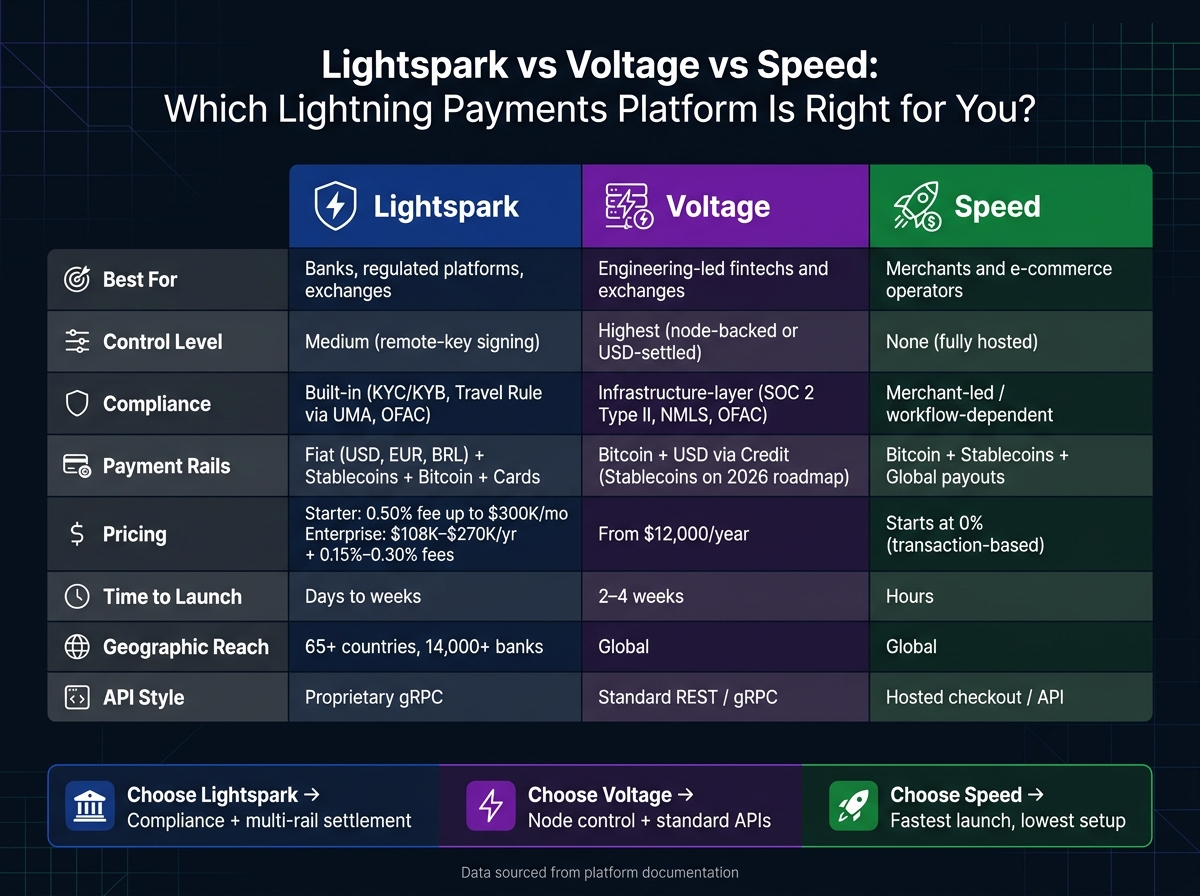
Lightspark vs Voltage vs Speed: Lightning Payments Platform Comparison 
Quick Comparison
| Criteria | Lightspark | Voltage | Speed |
|---|---|---|---|
| Best for | Regulated financial platforms | Engineering-led fintechs and exchanges | Merchants and e-commerce |
| Main product | Regulated payments platform | Managed Lightning infrastructure | Custodial payments product |
| Control level | Medium | Highest of the three | Lowest |
| Compliance | Built into the stack | Mostly on the customer side | Depends on workflow |
| Rails | Fiat, stablecoins, Bitcoin, cards | Bitcoin and USD via Credit | Bitcoin and stablecoins (including USDT on Lightning) |
| Launch time | Days to weeks | 2–4 weeks | Hours |
| Pricing signal | Higher enterprise spend | From $12,000/year | Public pricing not fully detailed |
My short take: pick Lightspark if regulation and multi-rail money movement come first, pick Voltage if your team wants to build on Lightning without self-hosting nodes, and pick Speed if you just want checkout or payouts live with the least setup work.
That’s the core decision the article makes, and the rest comes down to how much control your team wants to keep.
sbb-itb-d820943
Product Profiles: Where Each Platform Fits
Lightspark: Lightning Infrastructure for Regulated Financial Platforms
Lightspark pairs managed node infrastructure with Grid and Lightspark Connect. The result is multi-rail orchestration across fiat, stablecoins, and Bitcoin, along with a full compliance stack for KYC/KYB, OFAC screening, and Travel Rule support through UMA.
Its customer list tells you who this product is built for. Coinbase, Nubank, and Xapo Bank are among its users, which points to a strong fit for regulated financial platforms.[2]
| Lightspark | |
|---|---|
| Strengths | Full compliance stack (Travel Rule, OFAC, KYC/KYB), multi-rail reach (fiat, stablecoins, and Bitcoin), AI-driven liquidity via Predict, remote key signing |
| Limitations | Custom enterprise pricing and a proprietary gRPC API can add integration complexity [7] |
This matters most when compliance and multi-rail settlement sit at the top of the buying checklist.
Voltage: Managed LND Infrastructure for Teams That Want Node Control
Voltage runs managed LND nodes and liquidity for teams that want node control without the pain of self-hosting. You get a production-grade Lightning stack without having to build the whole thing yourself.
There are two ways to use it. With direct node control, your team keeps ownership over funds and keys. With the USD-settled Credit model, Voltage hides the nodes from view, so a business can use Lightning rails while settling in USD. That Credit model can settle at low latency with high reliability.[5]
Voltage is SOC 2 Type II attested and NMLS registered. But the KYC work at the application layer still sits with the customer.[1][6]
| Voltage | |
|---|---|
| Strengths | Node sovereignty or full abstraction (Credit model), SOC 2 Type II, 99.9% uptime SLA [1][6], standard REST/gRPC APIs, USD-settled Credit option |
| Limitations | Your team still owns payment logic and application-layer compliance; flexible pricing starts at $12,000 per year [7] |
That trade-off stands out once control and migration risk enter the picture.
Speed: A Ready-to-Use Bitcoin and Stablecoin Payments Product
Speed offers hosted checkout and payout workflows for merchants and operators that want Bitcoin and stablecoin payments live without dealing with nodes or liquidity. The provider runs the payment flow. The merchant just plugs it in.
This setup gives up low-level control in exchange for the fastest launch and the lightest operational load. Pricing starts at 0% for some workflows. Compliance duties vary by workflow.[4]
| Speed | |
|---|---|
| Strengths | Fastest time to market, no node or liquidity management, Bitcoin + stablecoin support, transparent 0%-starting pricing [4] |
| Limitations | Low node-level control, provider dependency for infrastructure, compliance responsibilities depend on the workflow |
That makes Speed the fastest path when launch speed matters more than infrastructure ownership.
Head-to-Head: Comparing by Buying Criteria
Now let’s compare these options by the things that usually make or break a buying decision: control, compliance, pricing, and launch effort.
Architecture, Control, and Migration Risk
Voltage gives teams the most day-to-day control for those who want to set up a Lightning node. Lightspark still lets the customer keep control of signing keys, while Speed hides the infrastructure almost entirely.
That same pattern shows up in migration risk. Voltage uses standard REST and gRPC APIs, so moving later is usually a moderate lift. Lightspark uses a proprietary API, which can mean more custom integration work. Speed is the easiest way to get started, but it’s also the hardest path if you later want direct control over the underlying stack.
| Factor | Lightspark | Voltage | Speed |
|---|---|---|---|
| Node model | Managed, with customer-controlled signing keys | Managed LND nodes | Fully abstracted |
| Key custody | Remote-key or managed | User-controlled or managed | Provider-managed |
| Liquidity control | AI-automated (Predict) | Managed or user-defined | Provider-managed |
| API style | Proprietary gRPC | Standard REST / gRPC | Hosted checkout/API |
| Switching costs | High | Moderate | Low |
Compliance, Rails, and Payment Scope
Lightspark is a regulated financial services company, and it builds KYC/KYB, OFAC screening, and Travel Rule support into its stack through UMA.[1][2] Voltage takes a different route. It covers compliance at the infrastructure layer with SOC 2 Type II attestation, NMLS registration, and OFAC screening on transaction paths, while application-layer KYC/AML remains the customer’s job.[6][5] Speed manages the payment flow, but compliance depends on the merchant’s workflow.
That split matters just as much as the payment rails. For regulated buyers, it can be the deciding line.
On rails, Lightspark’s Grid covers the broadest mix: Bitcoin, fiat (USD, EUR, BRL), stablecoins, and payouts to 65+ countries across 14,000 banks.[3] Voltage supports Bitcoin and USD through Voltage Credit, with stablecoins on its 2026 roadmap. Speed supports Bitcoin and a broad stablecoin set, plus global merchant payouts.
| Feature | Lightspark | Voltage | Speed |
|---|---|---|---|
| KYC/KYB | Built-in | Customer-managed | Provider-led |
| Travel Rule | Yes (UMA) | Not specified | Not specified |
| OFAC screening | Yes | Yes | Provider-managed |
| Stablecoins | Available | On roadmap | Available |
| Fiat settlement | USD, EUR, BRL | USD (via Credit) | Local currencies |
| Geographic reach | Global | Global | Global |
Pricing, Developer Experience, and Operational Burden
Lightspark’s Starter Plan has no monthly fee, but it charges a 0.50% transaction fee up to $300,000 in monthly volume. Its Enterprise plans cost $108,000 to $270,000 per year in platform fees, plus transaction fees between 0.15% and 0.30%.[7] Voltage starts at $12,000 per year, with Transaction-Only and Unlimited plans.[7] Speed is sold more like a packaged merchant payments product, and the provided material does not include public platform pricing.
For developer experience, the gap is pretty clear. Voltage is the best fit for teams that want standard APIs. Lightspark asks for more custom integration work. Speed is the fastest to launch.
"Voltage delivers [Lightning capability] for 80 to 90 percent less [than building in-house], live in weeks instead of months." – Bobby Shell, Voltage [5]
| Factor | Lightspark | Voltage | Speed |
|---|---|---|---|
| Public pricing | Tiered (Starter / Enterprise) | From $12,000/year | Transaction-based / not publicly detailed |
| Enterprise cost | $108K–$270K/year + fees | Custom / Unlimited plan | Not publicly detailed |
| Time to integrate | Days to weeks | 2–4 weeks | Hours |
| Lightning knowledge needed | Low (high abstraction) | Moderate | Minimal |
| Operational burden | Low (AI-managed) | Low (managed infra) | Very low (packaged) |
These trade-offs feed straight into the decision matrix below.
Decision Matrix: Which Platform Should You Choose?
Lightspark vs Voltage vs Speed: Decision Matrix
This matrix strips the earlier trade-offs down to the choices that tend to shape buying decisions.
| Factor | Lightspark | Voltage | Speed |
|---|---|---|---|
| Best-fit buyer | Banks, regulated platforms | Engineering-led fintechs, exchanges | Merchants, fast-moving operators |
| Node control | Low to moderate (remote-key option) | Moderate to strong (node-backed or USD-settled credit-backed) | None (fully hosted) |
| Compliance | Strong (KYC/KYB, Travel Rule, UMA) | Moderate (SOC 2, OFAC, NMLS) | Lightweight compliance (merchant-led) |
| Rails | Fiat, stablecoins, and Bitcoin | USD-settled via Credit | Stablecoin acceptance and global payouts |
| Pricing | Plan-dependent (Starter / Enterprise) | From $12,000/year | 0%-starting pricing |
| Time to launch | Days to weeks | 2–4 weeks | Hours |
Pick Lightspark, Voltage, or Speed Based on Your Operating Model
Choose Lightspark if you’re a bank, exchange, or regulated platform that needs one API for moving money across fiat, stablecoins, and Bitcoin. It also includes Travel Rule support through UMA [1][2]. If compliance and multi-rail coverage sit at the top of your list, this is the clearest match.
Choose Voltage if your team wants managed LND infrastructure with direct node control and standard REST/gRPC APIs. Its node-backed and USD-settled credit-backed models fit teams that want a tighter grip on how Lightning is deployed and run [1][7].
Choose Speed if you want a best bitcoin payment solutions with hosted checkout, stablecoin acceptance, and global payouts, without the extra work of managing Lightning infrastructure [4].
At that point, the decision gets pretty simple. Ask what matters most to your team:
- Compliance and multi-rail settlement: Lightspark
- Node control: Voltage
- Fastest launch: Speed
Conclusion: Match the Product to the Business Need
Lightspark, Voltage, and Speed each fit a different way of running Lightning payments. So the best pick comes down to a simple idea: choose the one that matches how your business works day to day.
That brings the decision into focus. Which setup fits your team, your risk profile, your compliance requirements, and the way you plan to move money?
Lightspark fits regulated institutions that need compliant multi-rail payments [1][2]. If your team wants more hands-on control than that, Voltage sits in the middle.
Voltage fits engineering-led teams that want Lightning control without self-hosting the stack [1][6].
If you want the lightest lift of all, Speed is the simplest path. Speed fits merchants that want a finished bitcoin and stablecoin payments product without infrastructure work [4].
Choose based on regulation, control, rails, and launch speed.
FAQs
Is Lightspark better than Voltage?
Not necessarily – Lightspark, Voltage, and Speed serve different needs.
- Lightspark is a good fit for regulated banks, exchanges, and neobanks that need fiat, stablecoins, Bitcoin, and compliance tools in one place.
- Voltage makes sense for engineering-led teams that want managed Lightning infrastructure with more control over how things run.
- Speed works well for operators who want a ready-to-ship Bitcoin and stablecoin payments product without having to run infrastructure themselves.
Is Voltage cheaper than Lightspark?
Not necessarily. Lightspark, Voltage, and Speed serve different use cases, so the price depends on what you need.
Pick Lightspark if you want a regulated, multi-currency platform with built-in compliance features. Go with Voltage if you need managed Lightning infrastructure and want more hands-on control. Choose Speed if you want a payment and payout product you can launch fast with very little integration work.
Does Speed replace Lightspark? Which handles compliance, travel rule, and OFAC? Do I need an LSP or my own node? How much does a Lightning node cost? Can these settle in stablecoin or fiat? Which has the best developer experience?
Not quite. Lightspark, Voltage, and Speed each fit a different job.
- Lightspark: a regulated platform with fiat, stablecoin, Bitcoin, and compliance tools
- Voltage: managed Lightning and Bitcoin infrastructure for teams that want more control
- Speed: a ready-to-ship payment product with very little infrastructure work
The right pick comes down to a few things: your compliance needs, how much control you want, which settlement rails you need, and how much integration work your team is ready to take on.
Related Blog Posts
{“@context”:”https://schema.org”,”@type”:”FAQPage”,”mainEntity”:[{“@type”:”Question”,”name”:”Is Lightspark better than Voltage?”,”acceptedAnswer”:{“@type”:”Answer”,”text”:”Not necessarily – Lightspark, Voltage, and Speed serve different needs. Lightspark is a good fit for regulated banks, exchanges, and neobanks that need fiat, stablecoins, Bitcoin, and compliance tools in one place. Voltage makes sense for engineering-led teams that want managed Lightning infrastructure with more control over how things run. Speed works well for operators who want a ready-to-ship Bitcoin and stablecoin payments product without having to run infrastructure themselves.”}},{“@type”:”Question”,”name”:”Is Voltage cheaper than Lightspark?”,”acceptedAnswer”:{“@type”:”Answer”,”text”:”Not necessarily. Lightspark, Voltage, and Speed serve different use cases, so the price depends on what you need. Pick Lightspark if you want a regulated, multi-currency platform with built-in compliance features. Go with Voltage if you need managed Lightning infrastructure and want more hands-on control. Choose Speed if you want a payment and payout product you can launch fast with very little integration work.”}},{“@type”:”Question”,”name”:”Does Speed replace Lightspark? Which handles compliance, travel rule, and OFAC? Do I need an LSP or my own node? How much does a Lightning node cost? Can these settle in stablecoin or fiat? Which has the best developer experience?”,”acceptedAnswer”:{“@type”:”Answer”,”text”:”Not quite. Lightspark, Voltage, and Speed each fit a different job. Lightspark: a regulated platform with fiat, stablecoin, Bitcoin, and compliance tools. Voltage: managed Lightning and Bitcoin infrastructure for teams that want more control. Speed: a ready-to-ship payment product with very little infrastructure work. The right pick comes down to a few things: your compliance needs, how much control you want, which settlement rails you need, and how much integration work your team is ready to take on.”}}]}


