How Bitcoin L2s Lightning, Rootstock, Spark and Liquid Interact
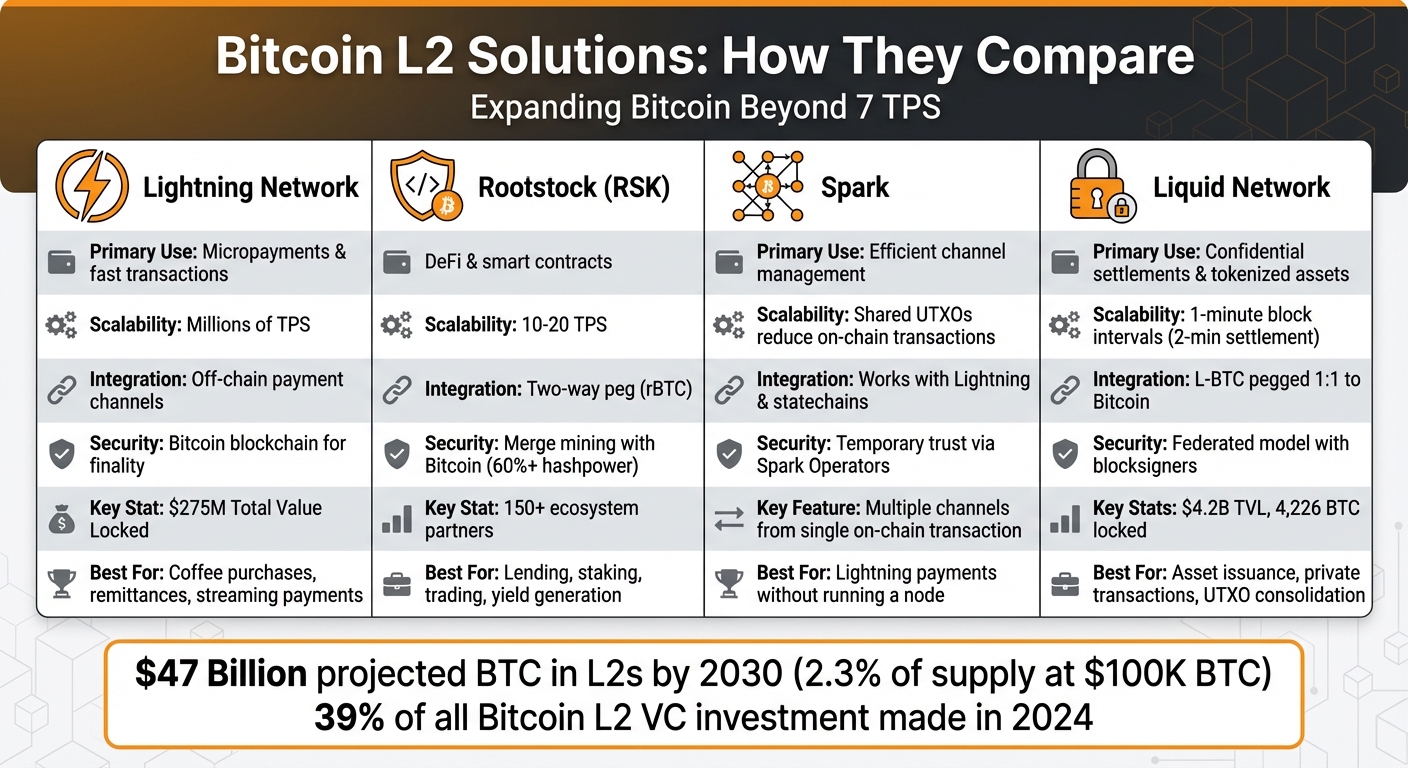
Bitcoin’s base layer processes only about 7 transactions per second, limiting its scalability for daily use. Layer 2 (L2) solutions address this by enabling faster, cheaper, and more versatile transactions while leveraging Bitcoin’s security. Here’s a quick overview of four key L2s:
- Lightning Network: Optimized for fast, low-cost micropayments using off-chain channels. Ideal for frequent, small transactions like buying coffee or sending remittances.
- Rootstock (RSK): Adds Ethereum-like smart contracts to Bitcoin, enabling DeFi activities like lending, staking, and trading, secured through merged mining.
- Spark: A channel factory that reduces on-chain transactions by creating multiple payment channels from a single setup. Works seamlessly with Lightning.
- Liquid Network: A sidechain for faster, private settlements and tokenized asset issuance, using L-BTC pegged 1:1 with Bitcoin.
Each L2 serves specific use cases but together expands Bitcoin’s utility, from instant payments to complex financial applications. By 2030, projections suggest up to 2.3% of Bitcoin’s supply could be integrated into L2s, representing a potential $47 billion market if Bitcoin reaches $100,000.
Quick Comparison:
| L2 Solution | Primary Use Case | Scalability | Integration with Bitcoin | Security Model |
|---|---|---|---|---|
| Lightning Network | Micropayments, fast transactions | Millions of transactions/second | Off-chain payment channels | Bitcoin’s blockchain for finality |
| Rootstock (RSK) | DeFi and smart contracts | 10–20 transactions/second | Two-way peg system (rBTC) | Merge mining with Bitcoin’s hashing |
| Spark | Efficient channel management | Shared UTXOs for scalability | Works with Lightning and statechains | Temporary trust via Spark Operators |
| Liquid Network | Confidential settlements, assets | 1-minute block intervals | L-BTC pegged to Bitcoin | Federated model with blocksigners |
These solutions complement each other, addressing Bitcoin’s limitations in speed, fees, and programmability. 
Bitcoin’s Layer 2 Dominance: Why There Is No Second Best | The Culture Bit w/ Janusz
1. Lightning Network
The Lightning Network is Bitcoin’s most widely used Layer 2 solution, designed to enable fast, low-cost transactions, making Bitcoin practical for everyday use. Unlike Bitcoin’s base layer, which can be slow and expensive for smaller transactions, the Lightning Network processes payments in seconds and reduces transaction fees to just a few cents[10]. This is achieved by shifting activity off-chain through two-way payment channels, offering a more efficient way to handle transactions.
Scalability
The Lightning Network’s scalability stems from its off-chain payment channels. When two participants open a channel, a record is created on Bitcoin’s blockchain that requires both parties to approve any spending[5]. Once the channel is active, it can handle thousands of transactions without broadcasting each one to the blockchain. Only the opening and closing of the channel are recorded on-chain[8]. This setup allows the network to theoretically process millions, or even billions, of transactions per second[5], making it ideal for fast, everyday payments.
“The Lightning Network addresses many of on-chain Bitcoin’s limitations through a network of bidirectional payment channels that enable instant, low-cost transactions while preserving Bitcoin’s fundamental security properties.” – Dr. Christian Decker, Swiss Bitcoin Institute[8]
Primary Use Cases
The Lightning Network is particularly effective for micropayments and frequent transactions where speed is a priority. It makes small payments – like buying a coffee, streaming content, or sending cross-border remittances – affordable and practical due to its minimal routing fees[8]. With over $275 million in total value locked, the network demonstrates growing adoption in real-world scenarios[1]. It also supports both direct payments and multi-hop transactions through intermediaries, expanding its utility for various financial interactions[2].
Integration with Bitcoin
The Lightning Network is tightly integrated with Bitcoin’s base layer, relying on actual Bitcoin transactions and native scripting[5]. The Bitcoin blockchain acts as a final arbiter, ensuring that only the most recent valid state of a payment channel is recorded on-chain. This design allows users to retain full control of their funds, with the option to exit to Bitcoin’s base layer at any time[9]. By using decrementing time-locks and smart contracts, the system ensures secure and atomic payments without over-relying on intermediaries[5].
Security Model
The Lightning Network’s security is rooted in Bitcoin’s blockchain. Payment channels function as multisignature addresses, ensuring that in case of a dispute, only the latest valid transaction is settled on-chain[5][8]. Bitcoin’s proof-of-work consensus guarantees the final settlement of transactions when channels are closed, reinforcing the Lightning Network as a secure extension of Bitcoin’s core infrastructure.
2. Rootstock (RSK)
Rootstock (RSK) is a Bitcoin sidechain designed to bring smart contract functionality to Bitcoin. Often referred to as the “Bitcoin DeFi Layer”, RSK allows developers to create advanced financial applications on Bitcoin using familiar tools and frameworks. Let’s dive into how RSK achieves scalability and expands Bitcoin’s capabilities.
Scalability
RSK tackles scalability by handling transactions on its sidechain and then settling them on Bitcoin’s main network. This off-chain processing reduces congestion on Bitcoin’s base layer, increases transaction capacity, and maintains decentralization. It achieves this through merge mining – a process where Bitcoin miners can secure the RSK sidechain using their existing proof-of-work setup, without incurring extra costs.
Primary Use Cases
RSK enables a wide variety of DeFi activities, all powered by Bitcoin (rBTC) as collateral. These activities include:
- Swapping
- Staking
- Yield generation
- Trading
- Borrowing and lending
- Providing liquidity
The platform has built an ecosystem of over 150 partners[11]. Some standout applications include Sushi for swapping and staking, Beefy for yield optimization, and Oku for trading. Sovryn, one of the leading DeFi protocols on RSK, reported nearly 8 BTC in 24-hour trading volume – equivalent to around $495,000[12]. RSK also supports stablecoins like Dollar on Chain (DOC), Brazilian Digital Token (BRZ), and Sovryn Dollar (DLLR), further expanding its financial offerings.
Integration with Bitcoin
RSK’s connection to Bitcoin is powered by a two-way peg system called PowPeg. This system allows users to lock BTC in a multi-signature wallet on the Bitcoin network, releasing an equivalent amount of RBTC on RSK. This seamless interoperability ensures that users can move between the two networks effortlessly, all while benefiting from Bitcoin’s robust proof-of-work security.
Security Model
RSK relies on merge mining to secure its operations, leveraging Bitcoin’s proof-of-work infrastructure. By combining Bitcoin’s established mining ecosystem with Ethereum-like smart contract capabilities, RSK extends Bitcoin’s functionality beyond simple transactions. This approach aligns with Bitcoin’s decentralization principles while enhancing its utility for more complex use cases.
3. Spark
Spark is a channel factory designed to cut down on the number of on-chain transactions. Unlike traditional Lightning channels – which require a separate on-chain transaction for each channel – Spark uses shared UTXOs (unspent transaction outputs) to create multiple bilateral channels from a single on-chain transaction [13]. This approach brings a new level of efficiency to managing channels.
Scalability
With Spark, participants can rebalance funds and open off-chain channels without incurring additional costs after the initial on-chain setup. As Roy Sheinfeld puts it:
“Ark and Spark revolutionize Lightning Network’s scalability in 2025, slashing on-chain transactions with shared UTXOs for fast, cheap Bitcoin payments.” [13]
This method maximizes the ratio of channels to on-chain transactions, making it one of the most efficient scaling solutions available. Its design ensures smooth integration with Bitcoin’s existing infrastructure, enhancing its scalability potential.
Integration with Bitcoin
Spark operates entirely within Bitcoin’s current consensus rules, requiring no soft forks or changes to the protocol. It leverages the concept of statechains, where users deposit funds into a shared-signature address managed jointly by themselves and a group of Spark Operators. Off-chain payments are facilitated through new withdrawal transactions, with operators deleting old keys to maintain a temporary trust model during transfers [13]. This system complements other scaling solutions by further reducing the need for on-chain activity.
Primary Use Cases
Spark works seamlessly with the Lightning Network, allowing users to make Lightning payments without needing to run their own Lightning node. In this model, Lightning Service Providers handle atomic swaps, which are triggered by cryptographic proof of successful Lightning payments [13]. This setup simplifies access to Lightning payments while maintaining efficiency and security./banner/inline/?id=sbb-itb-13628e1
4. Liquid
The Liquid Network, introduced by Blockstream in 2018, serves as a Bitcoin sidechain, functioning as a financial layer for Bitcoin [4]. Operating independently but in parallel with Bitcoin’s mainnet, it offers faster settlements and additional features while maintaining a two-way peg to the main chain. When Bitcoin is transferred to Liquid, it is converted into L-BTC, which retains a 1:1 peg with Bitcoin, enabling smooth scalability and usability.
Scalability
Liquid enhances transaction capacity with one-minute block intervals, allowing final settlements in just two minutes – much quicker than Bitcoin’s typical 10-minute block time [7]. This predictable block generation significantly increases the number of transactions processed in less time. On top of that, the network boasts an average fee rate of only 0.1 sat/vB. Currently, the federation holds 4,226.52 BTC, with a Total Value Locked (TVL) of $4.2 billion [14].
Primary Use Cases
Liquid is primarily designed for issuing and exchanging digital assets. It supports the creation of various assets, including stablecoins like USDT (valued at $97 million), tokenized securities such as BMN2 (valued at $645 million), and tokenized stocks like CMSTR (valued at $15.6 million) [14]. With its Confidential Transactions feature, Liquid ensures that transaction amounts and asset types remain hidden by default.
The network also assists Lightning Network node operators with channel rebalancing through trustless atomic swaps. For individual users, it offers an affordable way to consolidate UTXOs. Additionally, L-BTC can be securely stored in cold wallets, such as Blockstream Jade or Ledger devices [15].
Integration with Bitcoin
Liquid connects to Bitcoin through a secure two-way peg system. Pegging in requires 102 confirmations, while pegging out typically takes between 11 and 35 minutes [7]. The sidechain can also post block header hashes to Bitcoin for checkpointing its state. However, unlike the Lightning Network’s trustless unilateral exits, Liquid’s bridge requires users to rely on an intermediary when withdrawing funds.
Security Model
The network employs a Strong Federations model, relying on a group of blocksigners and watchmen to secure its operations [7]. While Liquid benefits from Bitcoin’s security principles as a Layer 2 solution, its independent consensus mechanism means it does not depend on Bitcoin’s data availability. This has led some critics to argue that Liquid’s architecture aligns more closely with a Layer 1 blockchain than a traditional Layer 2 solution [4].
Advantages and Disadvantages
Bitcoin Layer 2 (L2) solutions bring a mix of strengths and limitations, each contributing to Bitcoin’s evolving role in the digital economy. Here’s a breakdown of what each solution offers and where they fall short:
Lightning Network: This solution shines when it comes to scaling, as it can handle millions – even billions – of transactions per second through its decentralized payment channels. However, it comes with challenges like the need for active channel management, liquidity limitations, vulnerability to spam attacks, and risks from malicious channel closures [2]. While it supports basic payment functionalities, it lacks a global state or the capability to handle complex smart contracts.
Rootstock: Rootstock introduces Ethereum Virtual Machine (EVM)-compatible smart contracts, secured through merged mining that taps into over 60% of Bitcoin’s hashing power [6]. It processes around 10–20 transactions per second, which is a noticeable improvement over Bitcoin’s 5 TPS. That said, it operates under a committee-based governance model and uses its own token (RBTC), which raises concerns about centralization.
Liquid Network: This network prioritizes speed and privacy, enabling fast, confidential transactions with settlement times of just two to three minutes, thanks to one-minute block intervals. It also offers much lower fees compared to Bitcoin [7]. However, its federated model requires two-thirds consensus from a group of whitelisted signers, which limits users’ ability to withdraw funds independently.
Spark: Focused on enabling instant global payments [3], Spark shows potential, but its trade-offs and performance metrics are not yet well-documented, leaving some questions unanswered.
Each solution addresses specific needs while introducing its own set of compromises, reflecting the diversity in Bitcoin’s expanding ecosystem.
Conclusion
Bitcoin’s Layer 2 (L2) ecosystem is reshaping its role, evolving from a basic store of value into a versatile financial platform. With Lightning enabling near-instant payments, Rootstock introducing EVM-compatible smart contracts, Liquid securing tokenized assets and confidential settlements, and Spark supporting instant global payments, Bitcoin’s capabilities now extend far beyond simple peer-to-peer transactions.
The momentum behind these advancements is reflected in some compelling numbers. For instance, projections suggest that over $47 billion worth of BTC could be bridged into Bitcoin L2s by 2030. In addition, 39% of all historical venture capital investments in Bitcoin L2s were made in 2024, and wrapped Bitcoin on Ethereum has already surpassed $9 billion [4]. These trends highlight a growing demand for more productive ways to utilize BTC, with Bitcoin L2s aiming to meet this demand while keeping assets firmly within the Bitcoin ecosystem.
“The ability to use BTC in DeFi apps without exiting the Bitcoin ecosystem is a significant selling point for Bitcoin L2s. It may reduce friction in the user experience for bridging BTC and offer more secure alternatives to using BTC in DeFi beyond the solutions that exist today.” – Galaxy Research [4]
What makes this ecosystem particularly powerful is the way these Layer 2 solutions complement one another. Businesses can integrate Lightning for payments, Rootstock for smart contracts, and Liquid for tokenized securities, all while relying on Bitcoin’s robust security. This modular approach ensures that each solution addresses specific use cases while reinforcing the network’s core strengths. Developers and institutions can tailor their tools to individual needs without stepping outside Bitcoin’s trusted framework.
As the ecosystem matures, consolidation seems likely, with predictions pointing to just 3–5 dominant L2s in the future. Together, these solutions have the potential to elevate Bitcoin far beyond its current 7 transactions per second (TPS) limit, transforming it into a scalable and functional competitor to traditional financial systems. By enhancing scalability and utility, Bitcoin’s Layer 2 ecosystem is poised to unlock a new era of possibilities.
FAQs
How do Bitcoin Layer 2 solutions like Lightning and Rootstock improve scalability?
Bitcoin Layer 2 solutions are designed to tackle scalability challenges by handling transactions outside the main Bitcoin blockchain while still relying on its strong security framework. One prominent example is the Lightning Network, which facilitates swift and low-cost transactions through off-chain payment channels. Here’s how it works: users lock a small amount of Bitcoin on the blockchain, then conduct unlimited off-chain exchanges. Only the initial setup and final settlement are recorded on-chain. This approach not only eases congestion but also enables millions of microtransactions per second.
Another solution, Rootstock (RSK), functions as a sidechain linked to Bitcoin via a two-way bridge. It brings smart contract capabilities to Bitcoin and processes transactions in batches on its own blockchain. To maintain security and finality, periodic anchoring back to Bitcoin occurs. By shifting activity to the sidechain, Rootstock boosts Bitcoin’s transaction capacity without modifying its core protocol.
These advancements significantly increase Bitcoin’s efficiency, scaling its transaction capacity from the original 5–7 transactions per second on-chain to thousands off-chain. This makes Bitcoin more practical for everyday applications like payments, smart contracts, and asset transfers.
What are the security risks and benefits of using Bitcoin Layer 2 solutions?
Bitcoin Layer 2 solutions, such as the Lightning Network and Rootstock, build on Bitcoin’s security by periodically settling their transactions on the Bitcoin blockchain. This process, often referred to as “anchoring”, ensures that once off-chain transactions are recorded on the main chain, they gain the benefits of Bitcoin’s strong security and resistance to censorship. For instance, the Lightning Network is known for its ability to handle a high volume of transactions while still prioritizing security and privacy.
That said, these Layer 2 solutions come with their own set of risks. Because most activity occurs off-chain, users depend on intermediaries like channel participants or sidechain operators. This reliance can lead to challenges such as disputes, liquidity problems, or even malicious actions before transactions are finalized on-chain. Additionally, sidechains like Liquid and Rootstock use their own consensus mechanisms, which means users must place trust in their validators. This makes them less secure compared to Layer 2 solutions that directly settle on Bitcoin.
While Bitcoin Layer 2 solutions enhance scalability and functionality, users should weigh these benefits against the potential trust and operational risks involved.
What’s the difference between Liquid and Spark in improving Bitcoin transactions?
Liquid and Spark offer two distinct ways to improve Bitcoin transactions. Liquid functions as a sidechain, transferring BTC to its own network, known as Liquid Bitcoin (LBTC). This setup allows for quicker block times, confidential transactions that obscure amounts and asset types, and even supports the issuance and trading of tokens. However, it does come with a trade-off: it operates on a separate security model, independent of Bitcoin’s primary blockchain.
Spark, in contrast, stays rooted in Bitcoin’s main chain. By leveraging the Lightning Network, it enhances scalability while maintaining Bitcoin’s core infrastructure. Spark uses a FROST-based multi-signature scheme, enabling fast, low-cost transactions without the need for a sidechain or separate network.
To sum it up, Liquid prioritizes speed and privacy by utilizing a sidechain, while Spark focuses on scalability and efficiency directly on Bitcoin’s main network.