


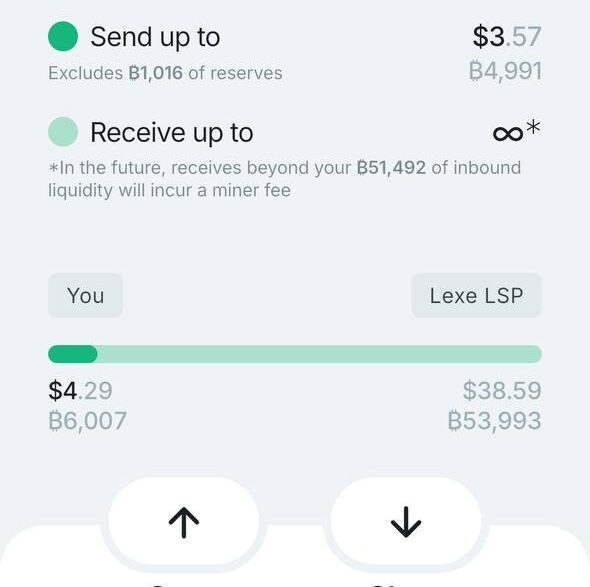
Lexe wallet is a brand new Lightning Wallet. Another Wallet? You must be kidding!
No. Not kidding.
Lexe is doing something new.
But first of all, let’s see how many boxes Lexe – pronounced ‘lek-see’ – already checks right off the bat;
- No setup fee
- Seamless install and initilalization
- Lightweight, no bloat
- Intuitive UIUX
- Competitive fees
- Self-custodial
- High payment success
- Lightning Addresses
- Human Bitcoin Addresses
The list continues, truly impressive what Lexe has put together, isn’t it? But can it deliver on its promise to be a “Lightning Wallet that finally works”?
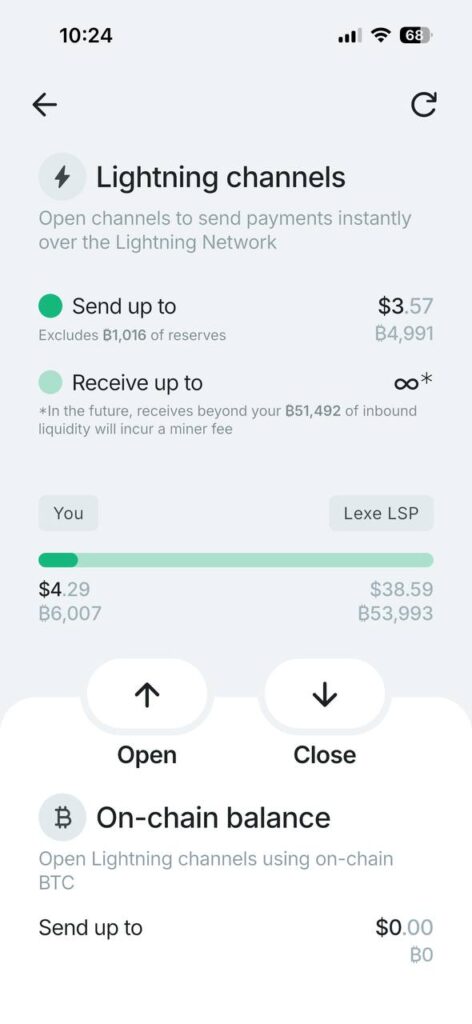
Lexe Wallet: A Lightning Wallet That Finally Gets It Right
We’ve tried more Lightning wallets than we care to count — Phoenix, Breez, Wallet of Satoshi, Mutiny — and one of the biggest frustration has always been the same: payments don’t complete because of connectivity issues with the node. Lexe tries to solve that, and it’s the first wallet with a completely new architecture.
Setup Was Shockingly Fast
Getting started took less than two minutes. You download the app, generate a seed phrase, and you’re live on Lightning. No channel management, no wrestling with inbound liquidity, no “sorry, your node is offline” messages. Lexe provisions your Lightning node for you inside a secure cloud enclave (a Trusted Execution Environment using Intel SGX), meaning the node is yours — they literally cannot touch your keys. That combination of self-custody + cloud hosting feels like the holy grail that Lightning developers have been chasing for years.
Always-On Payments
This is the headline feature, and it delivers. Your Lexe node runs 24/7 in the cloud even when the phone is dead or in airplane mode. We tested this by powering off my phone, having a friend send 5,000 sats, and turning it back on — the payment was settled. For anyone running a small business or accepting tips, this alone is a game-changer.
Human Bitcoin Address (BIP 353)
Every user automatically gets a Human Bitcoin Address — it looks like ₿awesome-zebra1@lexe.app . It’s essentially a Bitcoin email address. You paste it into any (BIP353) compatible wallet and they can pay you. No QR code needed, no invoice generation, no expiry timers. Lexe also falls back gracefully to the Lightning Address standard for wallets that don’t support BIP 353 yet . The UX here is miles ahead of fumbling with BOLT11 invoices.
Payment Options Are Comprehensive
Lexe supports essentially every modern Lightning payment standard out of the box:
- BOLT11 invoices (standard Lightning)
- BOLT12 offers (stateless, reusable payment codes)
- Lightning Address (e.g.
you@lexe.app) - Human Bitcoin Address / BIP 353
- On-chain Bitcoin
The just-in-time liquidity means you never have to pre-fund inbound capacity — it handles that automatically .
Developer-Friendly Backbone
What sets Lexe apart from other “consumer-first” wallets is its SDK layer . There’s a Python SDK (pip install lexe-sdk) and a Rust SDK for developers who want to embed self-custodial Lightning wallets directly into applications. The node binaries are reproducible builds, you can independently verify that what’s running in the cloud enclave matches the published open-source code. For anyone building Bitcoin payments infrastructure, this is a serious offering.
The Security Trade-off Worth Knowing
Lexe is not the same as running your own node at home. The node runs on Lexe’s servers inside an Intel SGX enclave. That means you trust the hardware security model, not Lexe as a company. Lexe cannot steal funds (the architecture prevents it), but if Intel SGX ever had a critical vulnerability, that assumption changes. It’s a reasonable trade-off for most users, but worth understanding before you put life-changing amounts on it. Treat it like a Lightning spending wallet, not a cold storage solution.
Bottom Line
Lexe is a smooth and polished self-custodial Lightning wallet. The always-online model solves Lightning’s biggest usability problem without sacrificing custody. The Human Bitcoin Address feature makes receiving as easy as sharing an email. It’s free to host your node, available on both iOS and Android, and the open-source, auditable codebase gives it credibility that custodial alternatives lack. If you run a Lightning node today and hate the operational overhead, Lexe is the upgrade you’ve been waiting for.
The Lexe Meganode is a core architectural innovation that makes free, self-custodial Lightning hosting economically viable. Here’s a full breakdown of why it exists and how it works.
The Problem Meganode Architecture Solves
Running a dedicated Lightning node for every single user in the cloud would be astronomically expensive. Each node traditionally needs its own memory allocation for the Lightning Network graph (a map of all channels and routing scores across the entire network), which alone can consume hundreds of megabytes per node. At scale with thousands of users, this becomes cost-prohibitive and impossible to offer for free.
What the Meganode Actually Is
Instead of spinning up a completely isolated process per user, Lexe runs hundreds of user nodes within a single enclave process. This is the “meganode” — one giant shared process that houses many individual Lightning nodes simultaneously. Think of it like an apartment building versus a field of separate houses: the structural shell is shared, but each unit (user) remains private and locked.
The Memory Efficiency Gain
The key insight is distinguishing between shared data and private data:
- Shared across all users (non-sensitive): The Lightning Network graph, routing scores, blockchain sync data — none of this is user-specific or sensitive, so it can be shared freely across all nodes inside the meganode
- Isolated per user (sensitive): Private keys, channel state, transaction history — these remain cryptographically isolated inside each user’s enclave partition
By sharing the network graph instead of duplicating it per user, Lexe achieves 10–100x reduction in per-user RAM consumption. This is the direct reason free hosting is economically sustainable.
Why Intel SGX Makes This Safe
The obvious concern is: if hundreds of users share the same process, can they see each other’s data? The answer is no, because of how Intel SGX Trusted Execution Environments work:
- Each user’s keys and channel state are encrypted and isolated at the hardware level
- Even Lexe’s own operators cannot read data inside the enclave
- The meganode process is structured so that shared components (network graph) are accessible to all, while private components are walled off per user
- TLS terminates inside the enclave, so communications between your phone and your node are end-to-end encrypted even from Lexe’s own servers.
LDK Is What Makes It Technically Possible
Lexe built this on top of the Lightning Development Kit (LDK), specifically because LDK separates Lightning protocol logic from I/O. A monolithic daemon like LND tightly couples all its components, making it impossible to surgically share some data while isolating others. LDK’s modular architecture lets Lexe run Lightning logic inside the enclave while delegating only the safe, non-sensitive I/O operations outside it, which is what enables the meganode pattern.
The meganode architecture is ultimately what makes Lexe’s business model work:
- Free node hosting becomes sustainable because the per-user infrastructure cost collapses by 10–100x
- Enterprise-grade 24/7 uptime is offered without passing costs to the user
- Developers using the SDK can spin up Lightning wallets programmatically without any per-node overhead
Without the meganode, Lexe would either need to charge users monthly fees or compromise on self-custody by running custodial infrastructure. The meganode is the architectural bridge that resolves Lightning’s long-standing trilemma of self-custody + convenience + low cost all at once.