


This article was originally published on Medium.
The Invoice Is Dead – A Manifesto for Continuous Settlement in the Energy Economy
Energy can no longer afford to settle in hindsight.
The Invoice Is a Product of Its Time
The invoice was designed for a world where energy usage had to be read after the fact, data arrived late, and reconciliation was a manual process. Settlement lag wasn’t a preference — it was a constraint. You measured what you could, when you could, and explained it later.
That world is gone.
Energy today is continuous, volatile, and deeply financialized. Large power relationships are shaped in real time by markets, tariffs, performance obligations, hedges, and operational decisions. Behind the meter — where solar, storage, demand response, and aggregation actively reshape consumption and value as it happens — the dynamics are even more pronounced.
Yet these relationships still come down to a single monthly bill that shows up after the fact, and that bill is treated as the point where both sides finally start trying to agree on what happened.
That no longer works at scale.
Invoices Don’t Settle Markets. They Postpone Agreement.
By the time an invoice arrives, energy has already been delivered and exposure already exists.
What follows is not settlement. It is reconstruction.
Each side reassembles what happened using its own data, assumptions, and models. Usage is rechecked. Pricing is rerun. Tariffs, pass-throughs, curtailments, and adjustments are debated. Payment waits while everyone works backward toward agreement.
Disputes are not an exception to this process. They are its natural result.
While agreement is delayed, the market runs on credit. Receivables accumulate. Suppliers finance wholesale obligations while waiting to be paid, and they respond by demanding deposits, collateral, and premiums — costs that ultimately flow through to customers.
The invoice doesn’t just describe the past. It dictates who finances whom, for how long, and at what cost, while everyone waits to agree.
Energy Is Continuous. Settlement Is Not.
Energy does not stop at month-end.
It is produced, consumed, priced, and optimized continuously. Congestion appears and clears. Performance obligations are met — or missed — interval by interval.
Behind the meter, this dynamic intensifies. Solar output fluctuates. Batteries respond to price and grid conditions. Flexible load shifts. Aggregators coordinate fleets. The economic reality of a contract changes throughout the day.
But financially, these activities are still stitched together after the fact.
Usage is netted later. Adjustments are reconciled later. Behind-the-meter performance and aggregation outcomes are often tracked on separate timelines, disconnected from the rest of the financial picture.
The result is a growing gap between when reality changes and when it shows up in settlement. As contracts grow larger and structures more complex, that gap widens. Exposure does not pause because a billing period ends. Risk does not reset because a document is issued.
Forcing a continuous system into discrete settlement windows introduces lag and uncertainty that compound with scale.
Delay Spreads Through the Value Chain.
Energy does not settle between two parties; it settles across a chain.
Power, payments, and risk move through markets — generators, utilities, suppliers, customers, brokers, aggregators, and service providers. Each participant holds partial information. Each depends on another’s timing. Each waits for someone else to close.
When settlement slows at one point, everything downstream feels it.
Payments pause while reconciliation runs. Reconciliation waits on missing data. One party cannot close until another does. What begins as a manageable delay turns into weeks of uncertainty as cash, confirmation, and credit inch through the system.
This model worked when markets were simpler.
Today’s energy system is more interconnected, more optimized, and more capital-intensive. In that environment, delay does not remain local. It propagates, and its cost grows with every additional handoff.
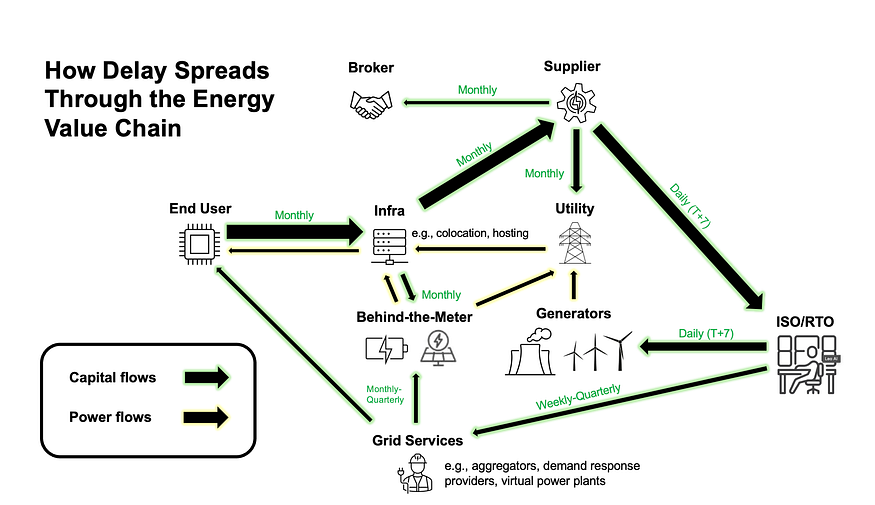
Representative power and capital flows in a deregulated market. Power moves continuously; capital moves in delayed, batched steps across a chain of counterparties. Not pictured: scheduling, trading, lending, insurance, and more.
Capital Is Forced to Guess.
The consequences extend well beyond buyers and sellers.
The capital that underwrites large energy relationships — lenders, insurers, and other risk-bearing counterparties — depends on visibility into what is actually happening. Today, that visibility is late, one-sided, and rarely validated against real-time operations.
Credit decisions rely on point-in-time financials. Risk is assessed using static reports. Exposure is inferred from contracts and history, not observed as it forms.
By the time issues appear, they are already old.
When capital cannot see, it prices uncertainty. Requirements increase. Buffers grow. Flexibility shrinks. The cost of risk rises precisely because it cannot be measured continuously.
Energy does not lack capital; it lacks capital that can see.
The Future Is Continuous Settlement.
Continuous settlement starts with a simple premise: information improves over time, and agreement should improve with it.
Usage, pricing, and performance are observed continuously. Corrections arrive. Adjustments are incorporated. The financial picture becomes more accurate as reality unfolds.
Settlement must operate the same way.
Instead of deferring agreement to a single moment, continuous settlement maintains a shared, continuously updated view of usage, pricing, and exposure based on the best available information at any point in time. Agreement exists throughout the life of the contract, not just at the end of a billing cycle.
Variances surface early, when they are small and explainable. Exposure is visible as it forms. Parties operate from the same financial reality instead of reconciling competing versions of the past.
There are still moments of reconciliation — predictable checkpoints where data is firmed and the current state of agreement is recorded. But settlement does not stop there. It continues to evolve as information improves.
This changes how capital operates.
Payment cadence becomes a choice, not a constraint. Credit and risk can be priced precisely, based on current information and confidence levels. Capital can move when it is efficient to do so, or remain deployed when that is the better economic decision.
This is not a faster billing process; it is a different operating model — and the only one that scales with the complexity of modern energy markets.
Shared Agreement Is a Prerequisite for Automation.
Energy is entering an era of autonomy.
Optimization, dispatch, risk management, hedging, and capital allocation are already too complex to manage manually at scale. Software — and increasingly agents — will make decisions on behalf of humans.
But automation cannot operate on stale or one-sided views of reality.
Systems cannot negotiate, optimize, or allocate capital against a truth that arrives weeks later. They require a shared, continuously updated state to act against.
Spreadsheets and PDFs force every participant to reconstruct the past independently. That model may survive human oversight. It collapses under automation.
Continuous settlement provides the foundation. With a shared contract-level settlement state that evolves as data improves, automated systems can coordinate actions, manage exposure, and keep counterparties aligned without constant human intervention. It is how optimization moves from analysis to execution, how workflows become exception-driven rather than manual, and how complexity becomes manageable.
This Is What Synota Is Building.
Synota is building the system of agreement for energy.
A system where settlement is continuous, agreement evolves with data, and confidence is explicit rather than assumed. Where each contract maintains a shared financial state that counterparties can rely on in real time.
This infrastructure is not designed for yesterday’s market. It is designed for the one emerging now — more dynamic, more interconnected, and increasingly automated.
Synota is building the foundation that allows energy, capital, and intelligence to move in sync. That is how serious energy markets will operate. The only question is who gets there early — and who keeps financing the past.