

There was once a young man shaped by scarcity — raised Lagos, taught by circumstance to spend whatever came into his hands because survival rarely left room for long-term thinking. His journey into Bitcoin did not begin with ideology or optimism, but with scepticism, and detours through the wider digital asset world.
Today, from his base in Anambra, he is building something far more grounded than internet speculation: a local Bitcoin movement rooted in trust, education, language, and daily commerce.
First Steps
- Before we talk about Bitcoin, take me back. Growing up in Lagos, what was your real, lived relationship with money?
I was born and raised in Lagos, on the rougher, less glamorous side of it, where poverty wasn’t just a backdrop but a daily reality. We’re talking broken roads, failed drainage systems, constant power outages, and streets that would flood or turn to mud at the slightest rain. I then moved to Anambra in 2021.
Growing up in that kind of environment shapes you in ways you don’t always notice immediately. My relationship with money was not a healthy one. When your surroundings are defined by scarcity and survival, you tend to develop a consumption mindset, and you spend what you get, because holding on to it never felt like an option.
Whenever money came my way, my first instinct was to spend it. That was genuinely where my joy came from. It took time and intentionality to unlearn that pattern.
- A lot of people hear about Bitcoin and shrug it off. Something clearly shifted for you. Was it a book, a person, a tweet? What was the click moment that made you think: this is different, this matters?
To answer that honestly, I have to tell my full Bitcoin story because the moment that truly changed everything for me wasn’t inspiration. It was a loss.
I first heard about Bitcoin in 2016. A friend of mine in college was getting paid in Bitcoin to view ads on one of the earliest Bitcoin faucet models. He introduced me to it, but I couldn’t afford the $100 required to participate, so I let it go and moved on.
Bitcoin didn’t cross my mind again until March 2020, when COVID-19 triggered a global shutdown, and Bitcoin’s price dropped sharply. That news pulled me back in, and I started reading about it seriously.
But as I explored deeper, I drifted away from Bitcoin into the broader digital assets and Web3 ecosystem because at the time, “Bitcoin-only” felt too narrow, too limiting.
That detour lasted until May 2022, when the LUNA collapse happened. I had staked LUNA, and when the crash began, I didn’t pull back — I actually kept buying on the way down, convinced it would recover. Before I could fully research what was causing the freefall, I had lost over 70% of my position. That was the moment I looked at the entire crypto ecosystem clearly and realised it wasn’t fundamentally different from what had just happened to LUNA.
That experience became my conviction. And honestly, lived experience is the strongest conviction there is. It brought me back to my first love — Bitcoin — and this time, I understood exactly why it stood apart.
- You recently shared that you ordered the full Saifedean House book bundle. What does it mean to you that Bitcoin has an intellectual tradition — that there are books, arguments, and philosophy behind it, not just price charts?
What I find most compelling about Bitcoin is that it doesn’t come alone; it comes with an entire education. When you go deep into Bitcoin, you inevitably start learning about money, finance, banking, geopolitics, and macroeconomics.
There are conversations I now engage in fluently that I would have had absolutely no framework for before Bitcoin found me. It has expanded my thinking in ways I didn’t anticipate.
And that’s what makes Bitcoin’s intellectual tradition so significant to me. It means the rabbit hole never really ends. There is always something new to understand, a new argument to wrestle with, a new layer of depth to uncover.
The books, the blogs, the Substacks, the podcasts, and the X Spaces are not supplementary material. They are part of the Bitcoin experience itself. Ordering the Saifedean bundle wasn’t just a purchase; it was a commitment to engaging with Bitcoin at that level, not just as an asset to hold, but as an idea worth understanding deeply.
Price charts tell you what the market thinks today. The intellectual tradition tells you why, and that foundation is what separates conviction from speculation.
Building
- First and foremost, congratulations on winning the grant from the Federation of Bitcoin Circular Economies. It surely sounds exciting on paper. But behind the scenes, before the meetups and the festivals — what were you actually doing? Were there any challenges you faced along the way to make this work?
Thank you! Before the grant, it was far from glamorous. I was doing what I could with what I had by organising small, low-budget hangouts within my immediate environment to talk to people about Bitcoin, and writing about Bitcoin on Blink’s blog to extend the conversation beyond my physical reach.
The biggest challenge throughout all of this was funding, and more than that, it was the uphill battle of talking to people who didn’t want to be talked to. A lot of people had already made up their minds that Bitcoin was a scam, and they wanted no part of it.
Breaking through that wall of misconception, repeatedly, with limited resources, was genuinely exhausting. Building a Bitcoin community from the ground up is not a light undertaking, especially in an environment where scepticism runs that deep.
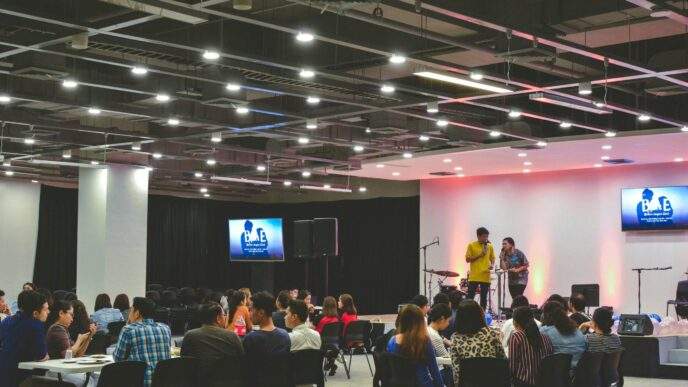
The grant from the Federation of Bitcoin Circular Economies changed the scale of what we could do significantly. It gave us the capacity to move from intimate gatherings to large-scale events like the Bitcoin Pizza Day, our ongoing Campus Tour, and merchant onboarding initiatives that we simply couldn’t have executed before. It was a turning point, not just logistically, but in terms of what we could credibly promise the community we were building.
- When you walked into a market/ shop and asked a trader to accept Bitcoin for the first time, what was their reaction, and how did you handle it?
It was quite an experience, and honestly, looking back, it was almost funny. I was called a scammer outright. They were convinced I had walked into their shop with another Ponzi scheme to steal their money, and nothing I said that day moved the needle even slightly.
But I didn’t leave feeling discouraged, and I’ll tell you why: because I understood exactly where they were coming from. I had been in that same place before. I once called Bitcoin a scam, too. And beyond my own past scepticism, the reality is that there are genuine bad actors out there running schemes that prey on everyday people.
There’s a real chance those traders had already been burned before, or knew someone who had. Their reaction wasn’t irrational; it was a defence mechanism built from experience.
What that encounter reinforced for me is that the barrier to Bitcoin adoption in these environments isn’t technical; it’s trust. And trust isn’t rebuilt with a single conversation. What people need is patient, consistent education and the space to arrive at their own conclusions with an open mind. That’s the work.
- You’ve built a circular economy in Awka. But what does “circular economy” actually mean in a place like Anambra, and why do you think it matters?
A Bitcoin circular economy, at its core, is about creating an ecosystem where Bitcoin is earned, spent, and accepted locally so that value circulates within a community rather than constantly converting in and out of fiat. And when I looked at Anambra, I saw a state that was almost built for this.
Anambra is defined by its enterprising spirit. Commerce isn’t just an activity here; it’s cultural. My people are traders by default, and the famous Igbo apprenticeship system has produced generations of business owners who understand value, exchange, and long-term thinking.
We are also home to Onitsha Main Market, the largest open market in West Africa and one of the largest on the continent, with several other significant markets spread across the state.
Add to that a thriving agricultural sector, and we grow and harvest our own rice locally, and you have an economy that is already deeply active and self-sustaining in many ways. Living here and experiencing all of this firsthand gave me the conviction that Anambra wasn’t just a good place to build a circular economy, it was one of the best.
The goal is to help merchants and business owners see Bitcoin not as a speculative asset, but as a tool that can connect their businesses to a global monetary network.
That is what Bitcoin Anambra is really about.
- Why Pidgin? What made you realise that language — not technology — was the real barrier to Bitcoin adoption?
This one is close to my heart. My own journey learning Bitcoin was genuinely difficult.
I wasn’t just learning about Bitcoin, I was researching the research. Listening to podcasts and stopping every few minutes to look up terms I didn’t understand, then looking up the explanations of those terms too. And this was before AI, before short-form summaries, before any of the learning shortcuts that exist today.
You had to sit with the information and digest all of it, slowly and deliberately. It was a lot. But I kept going because I had reached a point where I knew that Bitcoin was it for me, whether I found it easy or not.
Bitcoin Pidgin was born from that struggle. I built the resource I wished had existed when I was starting. The logic was simple; over 70% of Nigerians speak Pidgin, with an additional 30 million speakers across Africa. People are always more willing to engage with ideas in the language they are most comfortable in.
Language isn’t just a communication tool; it’s the difference between a concept feeling foreign and it feeling like it belongs to you. And the results have validated that instinct. We’ve had top Nigerian Bitcoiners and builders join our X Spaces, we’ve gone out to random locations to ask everyday people about Bitcoin, and we were part of the media team at the Africa Bitcoin Conference last year.
The traction has been real and consistent, which tells me the gap was always there. We’re just finally filling it.
- Using local language in serious financial education can attract criticism from purists. Have you faced that pushback? And what do you say to people who think simplifying the language is a disservice to the technology?
Honestly, I haven’t encountered that pushback directly, not yet. But when I do, my position will be straightforward: that the argument misses the point entirely.
We are at a stage where financial education on money, banking, and Bitcoin needs to reach everybody, not just those who are already comfortable in English or already embedded in global intellectual circles. Using local language is not a dumbing down of the subject matter. It is a deliberate choice to make the subject matter accessible to the people who arguably need it most.
Simplicity in language is not the same as simplicity in thought. The goal is comprehension, and if Pidgin gets us there faster and more effectively than formal English, then Pidgin is the right tool. Bitcoin is for everyone, and everyone deserves to receive it in a language that feels like their own.
- What have you personally seen the naira’s devaluation do to real families, real traders, real lives in Anambra? Try to put a face to the macroeconomics.
Anambra doesn’t just feel the effects of naira devaluation; it displays them openly every single day. Because we are a commerce-driven state with markets at the heart of daily life, price instability isn’t an abstract economic concept here. It is a lived experience.
You see it when you walk into a market and the price of something you bought last week has changed again, not because supply shifted, but because the currency holding those prices together continues to lose ground.
We see it up close, even with the merchants we have onboarded onto Bitcoin. They adjust the naira price of their goods frequently, not out of greed, but out of necessity. They have to, simply to stay in business. Our official inflation rate sits at around 15%, but anyone who actually shops in these markets knows that number tells only part of the story. The real experience on the ground is far more severe.
This is precisely why the naira’s devaluation is one of the first things we bring up when we begin educating people about Bitcoin here in Anambra. It requires no explanation; everyone already feels it. It is common knowledge with a human face.
The naira crisis is not a meme here. It is a daily reality, and I wrote about it extensively in 2024 — you can read it here.
Convictions
- Your social media opinions show a man who takes both his religious faith and his Bitcoin beliefs seriously. Some people would find that an unusual combination. How do you reconcile the two? Does one feed the other? Or do they occupy completely different rooms in who you are?
They are both deeply central to who I am, there is no reconciling needed because they have never been in conflict.
My faith is not something I practice on the side. It is the foundation of everything. Without God, I am nothing, and I mean that sincerely. Every step I take, every decision I make, is guided by that. So when I trace back how I found Bitcoin, the timing, the circumstances, what it has opened up for me and what I have been able to build through it, I genuinely do not see coincidence. I see intention. I believe God led me to Bitcoin, and I believe there is still more I am meant to contribute to this ecosystem.
And when I sit with both long enough, the connection becomes clear. Bitcoin is truth; mathematically verifiable, incorruptible, resistant to manipulation. God is truth; absolute, unchanging, incorruptible. They speak the same language in that sense. Both stand in opposition to systems built on deception and debasement. They don’t occupy different rooms. They share the same foundation.
So yes, if you want to call it a religion for me — laughs — I won’t argue with that.
- We talk a lot about what Bitcoin gives people. But deep commitment to anything comes with a price. What has this journey cost you in terms of time, relationships, or peace of mind? What’s the thing you’ve sacrificed that you rarely talk about publicly?
That is a genuinely deep question, let me think about it honestly.
What this journey has cost me most is comfort. And I don’t mean material comfort; I mean the quiet, unhurried kind. The kind where you have nothing pressing on your mind, nothing to build, no one waiting on a decision. That version of rest has largely left my life. There is no room for complacency in what I am doing, and truthfully, I have stopped expecting it. I am always on; managing teams, planning the next initiative, thinking through what comes next even in the moments that are supposed to be still.
The things I used to do purely for fun, with no agenda attached, have quietly faded into the background. I don’t talk about that much publicly, but it is real.
What I will say is that I have made peace with it. It is not a sacrifice I resent, it is one I have chosen to embrace, because the work is meaningful enough to justify it.
That said, I am not reckless about it. I take days off quarterly, deliberately, because burnout is a real threat in this kind of life and I have learned to respect that. Those breaks are not luxuries, they are maintenance. Without them, none of the work sustains itself.
- Forget the metrics and the press releases. In your vision, describe what Awka looks like in 10 years if everything you’re working toward actually happens — not in Bitcoin language, but in the language of daily life. What does a Wednesday morning look like for a market woman in Awka in 2036?
In my vision, that Wednesday morning looks ordinary, and that is exactly the point.
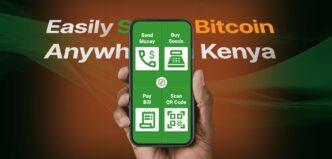
A market woman in Onitsha wakes up, sets up her stall, and goes about her day. At some point before noon, she makes a sale. Nothing unusual about that. Except the person on the other end of that transaction is not in Anambra. They are not even in Nigeria. They found her, they wanted what she was selling, and they paid her directly, instantly, without a middleman, without a bank, without a conversion fee eating into her margin. She received sats, and she knows what to do with them.
That is the vision. Not Bitcoin as a concept people have heard of, but Bitcoin as the invisible infrastructure behind everyday commerce, so seamlessly embedded into daily life that the market woman doesn’t think about the technology any more than she thinks about how her phone connects to a network. She just sells. The world buys. And Anambra is no longer a hub of local markets, it is a node in global commerce.
That is what I am building toward. Connecting this state, its traders, its farmers, its artisans to the world.
Not someday in theory, but in the lived, unremarkable routine of a Wednesday morning.