Choosing between Lightning and on-chain Bitcoin payments depends on speed, cost, and security needs. Here’s the quick breakdown:
- Use Lightning Network for fast, low-cost microtransactions like buying coffee or tipping online. Payments are nearly instant, and fees are minimal. However, managing channels requires some setup and monitoring.
- Choose on-chain transactions for larger, secure payments like buying a car or transferring Bitcoin to cold storage. These are slower and costlier but provide unmatched security and irreversible records.
Quick Overview:
- Speed: Lightning is near-instant; on-chain takes ~10 minutes or longer.
- Fees: Lightning fees are tiny; on-chain fees vary based on network activity.
- Security: On-chain offers full blockchain validation; Lightning is secure but requires channel management.
- Privacy: Lightning transactions are harder to trace; on-chain is fully public.
| Factor | On-chain Bitcoin | Lightning Network |
|---|---|---|
| Speed | ~10 minutes or more | Instant |
| Fees | Higher, depends on network | Lower, ideal for small transactions |
| Security | Maximum, fully validated | High, but needs channel oversight |
| Privacy | Public and traceable | Improved, but not perfect |
| Best for | Large payments, cold storage | Microtransactions, daily spending |
Bottom line: Use Lightning for quick, low-cost payments and on-chain for secure, high-value transfers.
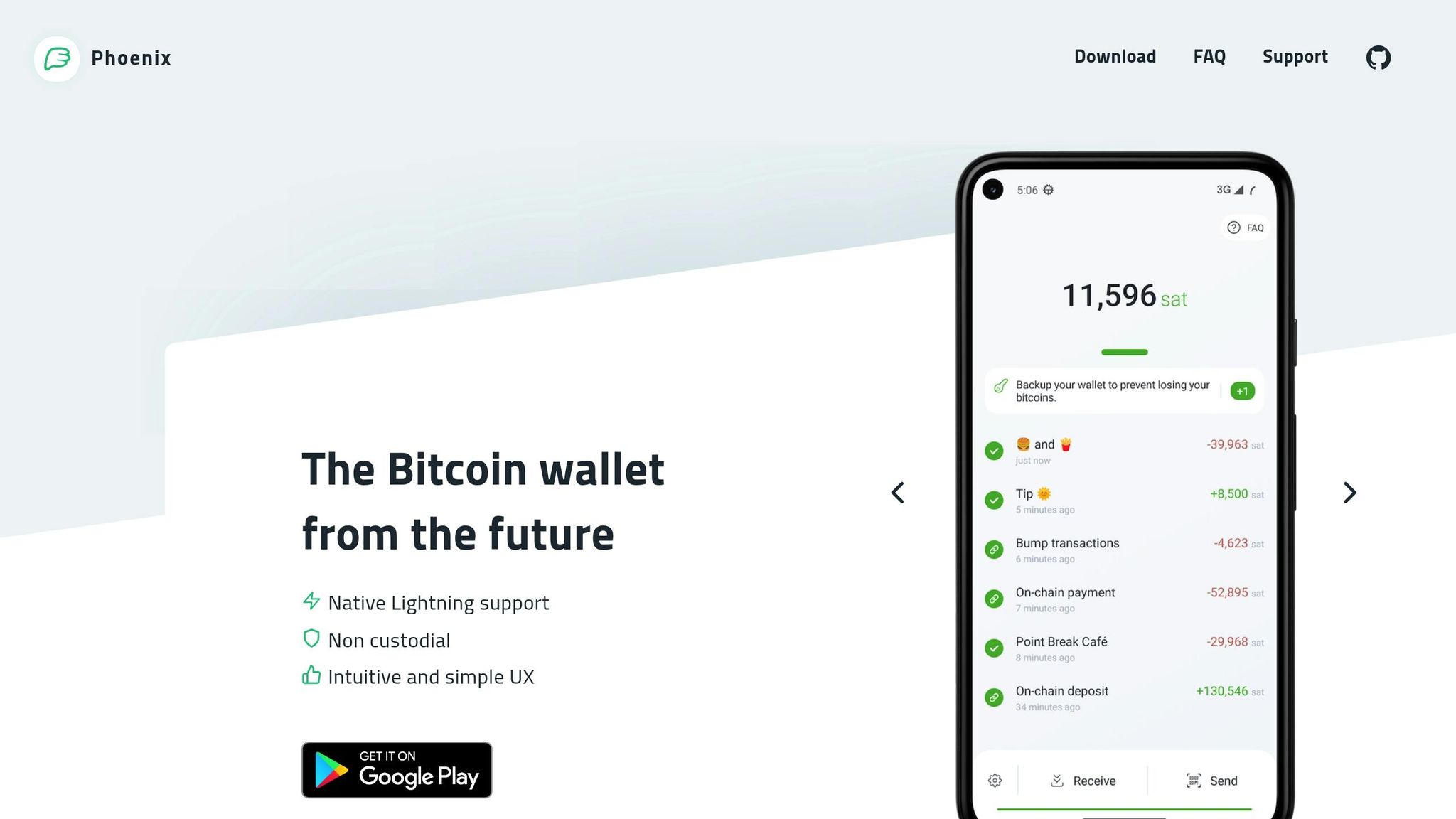
Phoenix Wallet: When To Use Lightning or On-Chain Bitcoin

How On-chain and Lightning Transactions Work
Let’s dive into the mechanics of how on-chain and Lightning transactions operate. While both methods enable Bitcoin payments, they process transactions in very different ways.
On-chain Transaction Mechanics
When you send Bitcoin through an on-chain transaction, you’re essentially broadcasting your payment to the entire Bitcoin network. Your transaction enters a pool of pending payments called the mempool, where it waits for miners to pick it up and include it in the next block.
Here’s how it works: you create a transaction by specifying the recipient’s Bitcoin address and the amount you want to send. Then, you digitally sign the transaction using your private key. This signed transaction is sent out to thousands of nodes across the Bitcoin network. Miners compete to solve complex mathematical puzzles, and the first to succeed gets to add your transaction – along with others – to a new block on the blockchain.
The initial confirmation of your transaction typically takes about 10 minutes. For added security, especially with larger payments, many recipients wait for 3–6 confirmations. This ensures the transaction is fully irreversible.
For example, if you’re buying a $50,000 Tesla with Bitcoin, the longer wait time and higher transaction fees of on-chain payments are negligible compared to the security and finality they provide.
Now, let’s see how the Lightning Network handles things differently.
Lightning Network Operations
The Lightning Network works off-chain, using private payment channels to enable near-instant and low-cost transactions.
To get started, you open a Lightning channel with an initial on-chain funding transaction. Once the channel is active, you and your channel partner can exchange payments instantly by simply updating the channel’s balance. The Bitcoin blockchain only records the channel’s opening and closing transactions, not the individual payments made within it.
What if you need to pay someone you don’t have a direct channel with? That’s where routing comes in. The Lightning Network uses interconnected channels to find a path for your payment. Your Bitcoin hops from one channel to another until it reaches the recipient, and the entire process happens in under a second.
Imagine you’re buying a $4 coffee at a café that accepts Lightning payments. You open your Lightning wallet, scan the QR code, and the payment is completed instantly. The café gets the Bitcoin right away, and you pay less than a penny in fees.
However, there’s a trade-off. Managing Lightning channels requires some effort. You need to monitor channel liquidity, ensuring there’s enough Bitcoin on the right side for outgoing payments. Occasionally, you’ll also need to close channels to access your funds on-chain. But for frequent, small transactions, this extra effort is worth it for the speed and cost savings.
Speed, Cost, and Scalability Comparison
Now that we’ve covered the mechanics, let’s dive into how speed, cost, and scalability stack up when comparing Lightning Network transactions to traditional on-chain Bitcoin transactions. These three factors often play a decisive role in choosing between the two.
Transaction Speed Differences
On-chain Bitcoin transactions rely on miners to confirm them, which means your transaction has to be included in a block. This process typically takes around 10 minutes but can vary depending on network congestion. By contrast, Lightning Network transactions are almost instantaneous. Whether you’re scanning a QR code or entering a Lightning invoice, payments are routed and settled immediately. This makes Lightning ideal for situations where speed matters most, like retail purchases or quick online payments.
Fee Structure and Costs
The cost of on-chain transactions is largely influenced by the size of the transaction in bytes and the level of network activity at the time[1][2]. During periods of high demand, fees can surge, which makes small on-chain transactions less practical.
In comparison, Lightning Network fees are determined by node operators. These fees typically include a small base fee per transaction plus a percentage-based fee. Since they’re measured in satoshis and are usually minimal, Lightning is especially economical for microtransactions. For larger transfers, the fee difference becomes less noticeable, and on-chain transactions may be preferred for their simplicity and enhanced security.
Network Capacity Limits
Bitcoin’s on-chain network is limited by block size and the 10-minute block interval, allowing it to process about 7 transactions per second. This cap can lead to delays and higher fees during busy times.
The Lightning Network, however, bypasses this limitation by routing payments through pre-established channels instead of recording each transaction on the blockchain. Its scalability depends on the routing capabilities of Lightning nodes and the liquidity available in these channels. While managing channel balances adds complexity, Lightning excels at handling a high volume of small, frequent transactions, making it a strong choice during periods of increased Bitcoin activity.
sbb-itb-d820943
Security, Privacy, and User Experience
When deciding between Lightning and on-chain Bitcoin payments, understanding the trade-offs in security, privacy, and user experience is key to making the right choice for your needs and comfort level.
Security Trade-offs
On-chain Bitcoin transactions provide the strongest level of security in the Bitcoin ecosystem. Each transaction is verified by thousands of miners globally and permanently recorded on the blockchain. Once a transaction gains multiple confirmations, it becomes irreversible and benefits from the full protection of Bitcoin’s network.
Lightning transactions also rely on Bitcoin’s security but introduce additional risks tied to channel management. For instance, if your Lightning wallet remains offline for too long, there’s a chance that a channel partner could broadcast an outdated transaction state. Many modern Lightning wallets include features like watchtowers or automated monitoring to mitigate this risk, but these tools add a layer of complexity.
After considering security, it’s important to weigh the privacy implications of each payment method.
Privacy Differences
Privacy is another area where these two methods differ significantly. On-chain Bitcoin transactions are publicly visible on the blockchain indefinitely. Anyone can see transaction amounts, the addresses involved, and the timing. While Bitcoin addresses don’t directly reveal personal identities, blockchain analysis can sometimes connect transactions to individuals, particularly if addresses are reused or linked to exchanges requiring identity verification.
In contrast, Lightning Network transactions are designed with improved privacy in mind. Payment details are not recorded on the public blockchain. Instead, payments are routed through multiple nodes, making it hard for outside observers to trace the full transaction path. Only the nodes directly involved in routing the payment have partial information, and they cannot see the entire transaction.
That said, Lightning’s privacy isn’t flawless. The initial channel opening and final channel closing transactions are still visible on the blockchain. Additionally, if you operate your own Lightning node, your channel balances and connections may be partially visible to the network.
Once privacy and security are evaluated, the ease of use and setup also play a role in the decision-making process.
User Experience and Setup
On-chain transactions are straightforward: create an address, share it, and wait for confirmations. Lightning wallets, on the other hand, require initial channel funding and setup. However, once the channels are active, payments are instant and seamless. Most Bitcoin wallets simplify on-chain transactions, making them beginner-friendly. The main task for users is selecting appropriate fee rates and waiting for confirmations.
Some wallets streamline the Lightning setup process by automatically opening channels or using hosted channel services, though these options may require placing trust in third parties.
After the initial setup, Lightning payments become quick and effortless. Transactions are completed instantly, with many wallets automatically managing routing and channel details. For frequent Bitcoin users, the upfront effort is often worth it, as subsequent transactions are faster and more cost-efficient.
| Factor | On-chain Bitcoin | Lightning Network |
|---|---|---|
| Security Level | Maximum security with full network validation | High security with added channel management requirements |
| Privacy | Public transaction visibility, address-based privacy | Improved privacy through payment routing |
| Setup Complexity | Simple wallet creation and address generation | Requires initial channel funding |
| Ongoing Experience | Wait for confirmations, higher fees during congestion | Instant payments, low fees, occasional channel maintenance |
| Best for Beginners | Simpler for occasional users | Better for frequent users after initial setup |
These factors – security, privacy, and user experience – can guide you in choosing whether on-chain or Lightning payments align better with your specific needs.
When to Use Each Payment Method
Understanding when to use on-chain payments versus the Lightning Network can help you make smarter decisions based on your transaction goals. Let’s break down the scenarios where each method works best.
Best Uses for On-chain Payments
On-chain Bitcoin transactions are your go-to option when you need a permanent and highly secure record of a transaction. These are perfect for larger purchases like buying a home, a car, or making significant business payments. While the fees may be higher and transactions slower, they’re a small trade-off when dealing with high-value transfers where security is paramount.
Another common use? Moving Bitcoin to cold storage wallets for long-term safekeeping. In these cases, the added costs and wait times are worth the peace of mind that comes with maximum security.
Best Uses for Lightning Payments
The Lightning Network, on the other hand, shines in situations where speed and low costs matter most. It’s ideal for micropayments – think buying a cup of coffee or tipping a content creator. These transactions are processed almost instantly with minimal fees, making it a practical choice for everyday spending.
Lightning also works well for streaming payments, enabling real-time value transfers for content subscriptions or pay-as-you-go services. It’s equally effective for frequent online purchases, gaming transactions, and even small cross-border payments, all thanks to its fast and cost-efficient nature.
Choosing the Right Method for Your Needs
Deciding on the best Bitcoin payment method depends on factors like transaction size, urgency, cost, and security. Here’s a breakdown to help you make the right choice.
Transaction size plays a key role. If you’re sending more than ₿0.01, the on-chain method offers stronger security, which justifies the higher fees. For smaller amounts, the Lightning Network is a better fit thanks to its tiny fees.
Urgency is another consideration. Need your payment processed in seconds, like when buying coffee or tipping? Lightning is the way to go. On-chain transactions, while slower due to confirmation times, are worth using when a slight delay is acceptable in exchange for maximum security.
Think about cost sensitivity too. Lightning transactions are incredibly cheap – often just fractions of a cent – making them ideal for frequent, everyday payments. On the other hand, on-chain fees can fluctuate based on network congestion, so it’s best for larger, less frequent transfers.
Security is a deciding factor as well. On-chain transactions provide robust protection through full blockchain validation, making them a solid choice for significant transfers or moving Bitcoin into cold storage. Lightning, while secure enough for daily use, is better suited for smaller, routine transactions.
In short, use on-chain for large, secure transfers and Lightning for quick, everyday payments. These two methods work together seamlessly, allowing you to switch between them based on your needs. By understanding these factors, you can choose the best payment method for any situation.
FAQs
How secure are Lightning Network transactions compared to on-chain Bitcoin payments?
The Lightning Network and on-chain Bitcoin payments each bring their own strengths to the table, especially when it comes to security, though they function in distinct ways. On-chain transactions are anchored directly to Bitcoin’s blockchain. Every transaction is validated and permanently recorded by a global network of decentralized miners. This process ensures a high level of reliability, making it a solid choice for large-scale or critical payments.
On the other hand, the Lightning Network offers a quicker and more cost-efficient alternative by operating through off-chain channels. These channels are secured using smart contracts and still depend on Bitcoin’s blockchain as their foundation. However, they might not provide the same level of security as on-chain transactions. For everyday purchases or microtransactions, the Lightning Network strikes a balance between security and efficiency, making it an ideal option.
How do I set up and manage a Lightning Network channel for Bitcoin payments?
To get started with managing a Lightning Network channel for Bitcoin payments, the first step is to fund your Lightning wallet. This involves an on-chain transaction where you transfer Bitcoin into the wallet. Once your wallet is ready, you’ll need to connect with a peer. To do this, obtain their public key and connection address.
After establishing a connection, you can open a channel. Specify how much Bitcoin you want to allocate to the channel, enter the peer’s details, and set the transaction fee. Keep in mind that the channel will only become active after it is confirmed on the blockchain, which usually takes a few confirmations.
Once your channel is up and running, regular monitoring is key. Check its activity to ensure everything is functioning smoothly. Over time, you might need to rebalance the channel to maintain liquidity, especially if you’re processing a lot of transactions. Staying on top of channel management is essential for keeping payments flowing efficiently.
Can I use the Lightning Network for large Bitcoin payments, or is it only good for small transactions?
The Lightning Network is designed to handle quick and smaller transactions, but it’s also capable of managing larger payments under the right conditions. The maximum amount you can send depends on the capacity of the payment channels involved. Over time, these channel capacities have expanded, allowing for larger payments to be processed more reliably.
One helpful feature of the Lightning Network is multi-path payments. This allows a single transaction to be divided into smaller portions and sent through multiple channels. By doing this, the chances of successfully completing larger payments increase. That said, for very large transactions, you might find that on-chain payments are a more suitable choice, depending on your specific requirements.
{“@context”:”https://schema.org”,”@type”:”FAQPage”,”mainEntity”:[{“@type”:”Question”,”name”:”How secure are Lightning Network transactions compared to on-chain Bitcoin payments?”,”acceptedAnswer”:{“@type”:”Answer”,”text”:”The Lightning Network and on-chain Bitcoin payments each bring their own strengths to the table, especially when it comes to security, though they function in distinct ways. On-chain transactions are anchored directly to Bitcoin’s blockchain. Every transaction is validated and permanently recorded by a global network of decentralized miners. This process ensures a high level of reliability, making it a solid choice for large-scale or critical payments. On the other hand, the Lightning Network offers a quicker and more cost-efficient alternative by operating through off-chain channels. These channels are secured using smart contracts and still depend on Bitcoin’s blockchain as their foundation. However, they might not provide the same level of security as on-chain transactions. For everyday purchases or microtransactions, the Lightning Network strikes a balance between security and efficiency, making it an ideal option.”}},{“@type”:”Question”,”name”:”How do I set up and manage a Lightning Network channel for Bitcoin payments?”,”acceptedAnswer”:{“@type”:”Answer”,”text”:”To get started with managing a Lightning Network channel for Bitcoin payments, the first step is to fund your Lightning wallet. This involves an on-chain transaction where you transfer Bitcoin into the wallet. Once your wallet is ready, you’ll need to connect with a peer. To do this, obtain their public key and connection address. After establishing a connection, you can open a channel. Specify how much Bitcoin you want to allocate to the channel, enter the peer’s details, and set the transaction fee. Keep in mind that the channel will only become active after it is confirmed on the blockchain, which usually takes a few confirmations. Once your channel is up and running, regular monitoring is key. Check its activity to ensure everything is functioning smoothly. Over time, you might need to rebalance the channel to maintain liquidity, especially if you’re processing a lot of transactions. Staying on top of channel management is essential for keeping payments flowing efficiently.”}},{“@type”:”Question”,”name”:”Can I use the Lightning Network for large Bitcoin payments, or is it only good for small transactions?”,”acceptedAnswer”:{“@type”:”Answer”,”text”:”The Lightning Network is designed to handle quick and smaller transactions, but it’s also capable of managing larger payments under the right conditions. The maximum amount you can send depends on the capacity of the payment channels involved. Over time, these channel capacities have expanded, allowing for larger payments to be processed more reliably. One helpful feature of the Lightning Network is multi-path payments. This allows a single transaction to be divided into smaller portions and sent through multiple channels. By doing this, the chances of successfully completing larger payments increase. That said, for very large transactions, you might find that on-chain payments are a more suitable choice, depending on your specific requirements.”}}]}