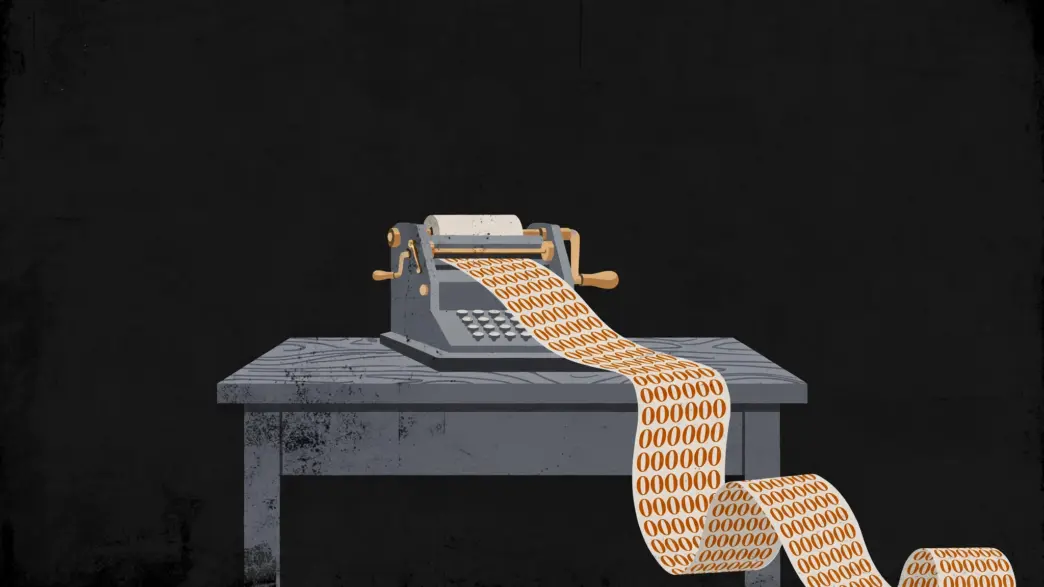
In the autumn of 1923, German physicians reported a new nervous malady among the country’s bookkeepers, cashiers, and bank clerks. Its name was “zero stroke,” or “cipher stroke.” The afflicted were, by most accounts, perfectly normal in every respect but one: they had developed an irresistible desire to write endless rows of zeros.
It sounds like a music-hall joke, and it may partly have been one. But the laughter had a frightened edge. The men and women who filled the ledgers of the Weimar Republic were the people who watched, digit by digit, as the German mark ceased to function as money. If anyone was going to break under the arithmetic, it was them.
A currency in free fall
The numbers still have the power to stun, a century on. At the start of 1921, the mark stood at roughly 60 to the US dollar: battered by defeat, reparations, and debt, but recognisable as a currency. By November of that year it had fallen to about 330 to the dollar. By December 1922, it took 8,000 marks to buy what a single dollar bought. The end, when it came in November 1923, was almost beyond notation: one trillion paper marks to a single gold mark, and a dollar priced in the trillions.
The mechanics are familiar to any student of monetary collapse. The Treaty of Versailles had loaded Germany with reparations it could not pay in a currency anyone wanted. The government ran deficits and printed marks to cover them. When French and Belgian troops occupied the Ruhr in January 1923, after Germany defaulted on deliveries of coal and timber, Berlin financed passive resistance in the industrial heartland with yet more printed money. Each turn of the press made the next turn necessary. 
What this meant in daily life is harder to hold in the mind than the exchange rates. Prices did not merely rise; they dissolved. Workers demanded payment at the start of the day and were given half an hour to spend their wages before they shrank. Liaquat Ahamed, in Lords of Finance, records the period’s defining vignette: in the time it took to drink a cup of coffee, the price of the coffee could double. Banknotes, printed in ever larger denominations, ended up papered onto walls, because the notes were worth more as decoration than as money.
The diagnosis
It was in this atmosphere that zero stroke entered the newspapers. Time magazine, in December 1923, described it under the headline “Cipheritis”: with the price of bread “running into billions a loaf,” the German people had been forced to count in thousands of billions, and physicians blamed the strain for a disease whose sufferers felt compelled “to write endless rows of ciphers and engage in computations more involved than the most difficult problems in logarithms.”
The Reading Eagle, relaying a Philadelphia report the same month, defined it as “the nervous affliction of bookkeepers who grow dizzy from the number of ciphers that must be set in a row after the integers before German marks are sufficiently numerous to come within hailing distance of real money.”
Beyond the compulsion to write zeros, the accounts claimed that sufferers lost their grip on magnitude itself, announcing that they were ten billion years old, or the parents of forty trillion children. John Kenneth Galbraith, retelling the episode half a century later in Money: Whence It Came, Where It Went, wrote of “scores of cases” reported “among men and women of all classes, who have been prostrated by their efforts to figure in thousands of millions.”
Did it exist?
A modern historian reads these reports with a raised eyebrow. Zero stroke was never a diagnosis with a clinical literature behind it; it survives as newspaper colour, repeated by Galbraith and Ahamed because it captures something true about the period rather than because case files document it. Weimar Germany was also a culture reaching, half-seriously, for medical language to describe a collective derangement: the speculator’s mania, the dancer’s frenzy, the saver’s despair. A country whose money had gone mad was bound to invent a madness of money.
And yet the invention was not arbitrary. The people said to suffer from zero stroke were not the speculators who grew rich on inflation, borrowing marks and repaying in confetti. They were the salaried counters of other people’s money, the clerks and cashiers whose craft rested on a simple faith: that a number written in a ledger today would mean the same thing tomorrow. Hyperinflation did not merely impoverish them. It abolished the stable unit on which their working lives, and everyone’s savings, depended. The compulsive zeros, real or embellished, are what a mind looks like when the measuring stick will not stop stretching.
The cure was a new unit
The episode ended the way hyperinflations usually end: not by repair, but by replacement. In November 1923 the government introduced the Rentenmark, exchanged at one trillion paper marks to one. The new currency was notionally backed by land and industrial assets, a confidence device as much as a financial one, but the printing stopped, the fiscal bleeding was staunched, and the zeros stopped multiplying. Within a year Germany had a functioning currency again, and the bookkeepers of Berlin could go back to writing numbers that stayed written.
The lesson that survives is not really about medicine. It is about what a unit of account does to the people who think in it. Money is the one number every citizen is forced to hold in their head, every day, whether they work in a bank or a bakery. Corrupt that number, multiply it by a trillion, and the corruption shows up everywhere: in contracts no one will sign, in savings no one will keep, in wages spent at a run, and, if the physicians of 1923 are to be believed, in minds that could no longer stop counting.
A century later, the zeros accumulate in different places: in public debts quoted in tens of trillions, in central bank balance sheets that expand by figures no ledger clerk could write out by hand. They arrive more slowly, and with better public relations. But the Weimar clerks understood something that their successors prefer to forget. A currency’s first casualty is not its exchange rate. It is the citizen’s confidence that the numbers mean anything at all.
Bitcoin was designed, in the shadow of a different financial crisis, as the opposite experiment: a monetary unit whose supply no committee can expand, capped at 21 million, divisible into satoshis rather than inflated into ciphers. Whether or not it succeeds, its founding intuition is the one the zero stroke story teaches. Give people a number that cannot be multiplied against them, and they can stop counting, and get on with their lives.