
Yes, you can build a Bitcoin retirement plan at almost any age. The path just changes based on your time frame, income, assets, and how much price swing you can handle.
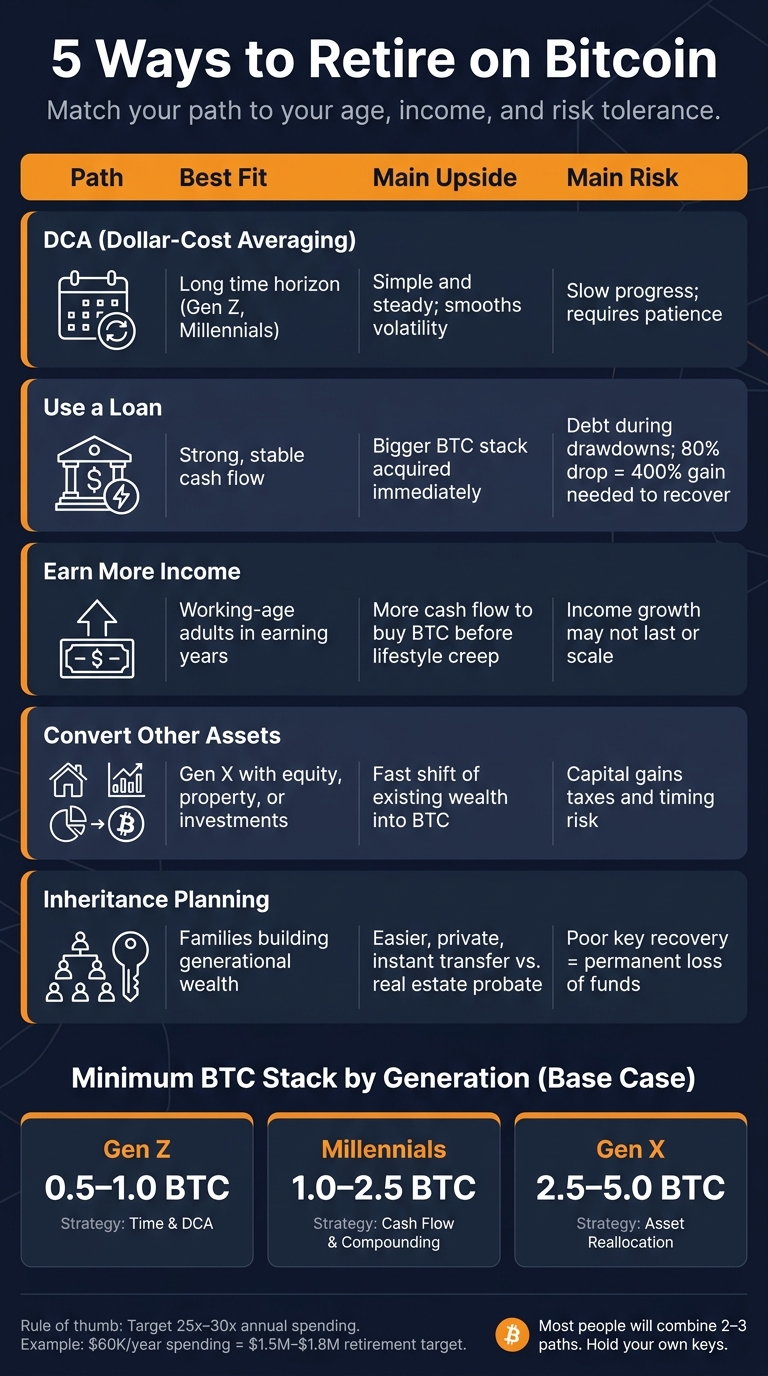
Here’s the short version: this article breaks retirement on Bitcoin into five paths:
- DCA over time if you want a simple, steady approach
- Use a loan if you want a bigger BTC position now and can handle the payment risk
- Earn more income and send part of it into Bitcoin before lifestyle costs eat it up
- Sell other assets like stocks, property, or a second car to buy BTC
- Set up family transfers so heirs receive Bitcoin instead of property
The article also makes three big points:
- Your target stack depends a lot on age and time left until retirement
- Volatility matters because Bitcoin can fall 50% to 80%
- Retirement is not just about buying BTC – it’s also about taxes, custody, withdrawals, and inheritance
A simple rule used in the piece is to estimate retirement needs as about 25x to 30x annual spending. So if you expect to spend $60,000 per year, you’d want assets worth about $1.5 million to $1.8 million at retirement. In a Bitcoin plan, that means your BTC value has to cover that number when you stop working. 
The article’s main takeaway is simple: most people will not use just one path. They’ll likely combine steady buys, income growth, and maybe asset sales, then use cold storage for long-term holdings and a Lightning wallet for day-to-day spending.
5 Ways to Retire on Bitcoin: Paths, Risks & Best Fit by Age
Skip 30 Years of Work With This Bitcoin Retirement Plan
sbb-itb-d820943
Quick Comparison
| Path | Best fit | Main upside | Main risk |
|---|---|---|---|
| DCA | Long time horizon | Simple and steady | Slow progress |
| Loan | Strong cash flow | Bigger BTC stack now | Debt during drawdowns |
| Higher income | Working years | More money to buy BTC | Income may not last |
| Asset conversion | People with equity or investments | Fast shift into BTC | Tax hit and timing risk |
| Inheritance planning | Families building generational wealth | Easier transfer of wealth | Poor key recovery setup |
If I had to sum it up in one line: the article is about matching the right Bitcoin retirement path to your age, cash flow, and risk level – then making sure you can hold through big drops and still access your coins later.
What ‘Retiring on Bitcoin’ Actually Means
Retiring on Bitcoin means using BTC as your long-term retirement asset instead of dollars, so inflation and currency debasement have less impact. The point is simple: protect your purchasing power over time.
A common rule of thumb is to take your annual spending and multiply it by 25 to 30. In Bitcoin terms, that means your target stack needs to support your yearly withdrawals based on the BTC price when you retire. Put another way, your minimum stack is the amount of BTC value needed to pay for your annual spending in retirement.
That number doesn’t stay fixed. It changes with age, because the amount of time you have left in the market changes how much risk you can handle.
If you’re younger, you usually have more time to ride out sharp swings. If you’re older, protecting what you already have starts to matter more. And the math can get brutal fast: a 50% drop needs a 100% gain to recover.
That’s why the next sections use different stack targets and tactics for different age groups. With that starting point in place, the five paths below show how to build the stack.
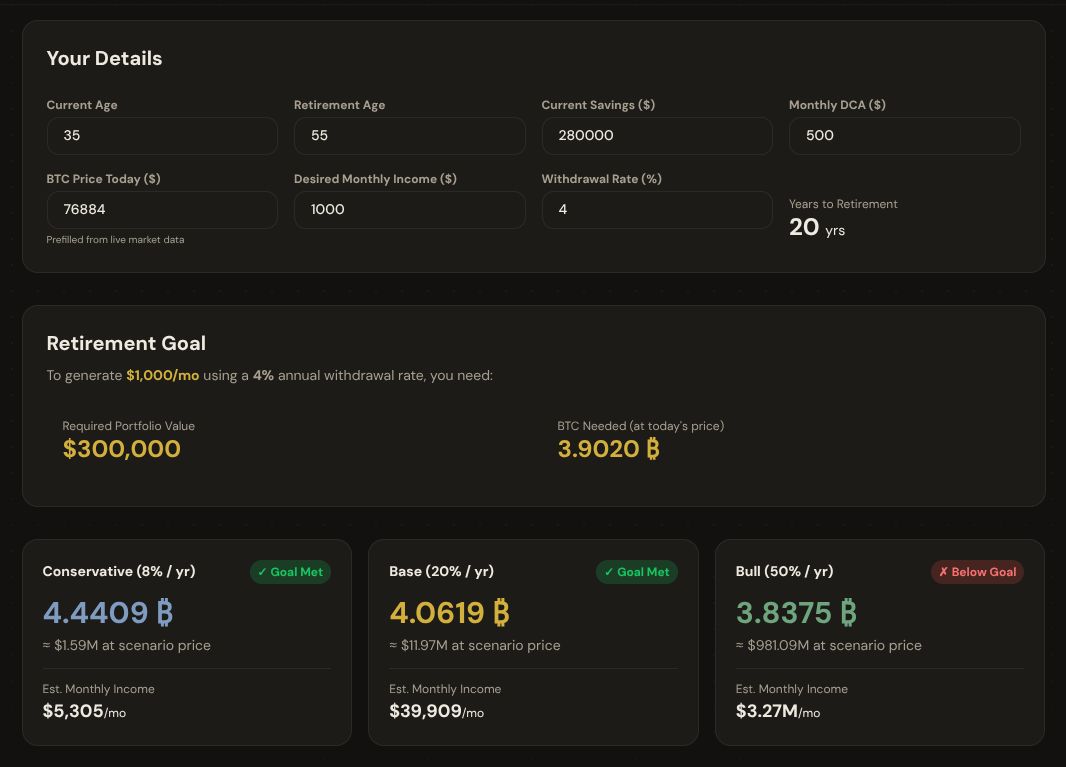 Bitcoin Retirement Calculator by BitcoinPension.com
Minimum Bitcoin Stack by Generation
How much Bitcoin you need comes down to one big factor: time.
The same retirement target won’t look the same at 25, 40, or 55. A younger buyer has more years to stack and sit through market swings. Someone closer to retirement has less room for error and less time for compounding to do the heavy lifting.
Use the ranges below as a benchmark before you pick the path that lines up with your income, age, and timeline.
| Generation | Strategy Focus | Aggressive Scenario | Base-Case Scenario | Conservative Scenario |
|---|---|---|---|---|
| Gen Z | Time & DCA | 0.1–0.25 BTC | 0.5–1.0 BTC | 2.0–5.0 BTC |
| Millennials | Cash Flow & Compounding | 0.25–0.5 BTC | 1.0–2.5 BTC | 5.0–10.0 BTC |
| Gen X | Asset Reallocation | 0.5–1.0 BTC | 2.5–5.0 BTC | 10–20+ BTC |
Gen Z has one big edge: time. Small, automated buys can add up over the years, which makes weekly DCA a workable way to build a meaningful stack without needing a huge starting budget.
Millennials need consistency more than hero moves. Steady monthly buys matter, and so does staying calm when the market gets ugly. Panic-selling during a 50%+ drawdown can wreck compounding fast.
Gen X has the shortest runway, often just 5 to 15 years until retirement. That usually means bigger monthly buys, selling other assets into BTC, or both, if the goal is to close the gap in time.
With the target set, the five paths below show how to get there.
1. Start DCAing Bitcoin Now With a FIRE Plan
Dollar-cost averaging, or DCA, can work at almost any stage of life. Gen Z can start small. Millennials can build during their prime earning years. Gen X can still make progress as retirement gets closer. Boomers can keep adding too.
The setup is simple: choose a fixed dollar amount, set a buying schedule, and stick with it. When Bitcoin drops, that same amount buys more. When it climbs, it buys less. That steady rhythm matters. Treat Bitcoin like a long-term savings plan, not a side bet, as you get into Bitcoin for the first time. If your FIRE number still feels far off, DCA is one of the simplest ways to keep closing the distance.
Minimum BTC Stack by Age
The biggest factor is time. More years means more room to compound. That gives early starters more flexibility. If you’re getting a later start, you usually need to buy at a faster pace.
So the question isn’t just how much Bitcoin should I own? It’s also: how much can I keep buying month after month for the next 5, 10, or 20 years? Bitcoin fits long-term savings better than short-term spending. [1]
Monthly Cash-Flow Requirement
A good DCA plan should be small enough that you can keep it going even in an annoying month. That’s the whole game. If the plan breaks the moment life gets expensive, it won’t last.
Even $20 per week is enough to start building a stack without dipping into rent money, bill money, or your emergency fund. Weekly buys can help smooth out volatility and make the habit feel more natural. [1]
A few rules matter here:
- Keep fees low, because even small charges add up over 10 or 20 years.
- Only DCA money you won’t need for at least five years. [1]
Downside Risk and Volatility Tolerance
Bitcoin can drop 50% to 80% during bear markets. That’s normal for the asset, and it’s part of why DCA can work for patient buyers. [1]
The bigger risk isn’t the drop itself. It’s panic-selling during the drop. That’s where people get hurt. Your buy size should be small enough that a rough stretch doesn’t make you want to quit. If the stack grows into a bigger balance, move it to self-custody.
That’s why the amount you buy has to match your timeline, your cash flow, and your stomach for volatility.
Time Horizon to Retirement
The earlier you begin, the less you usually need to buy each month. A longer runway gives you more room to accumulate at a slower pace. A shorter runway means the weekly buy likely needs to be higher if you want to reach the same target.
If plain DCA feels too slow, the next move is to look at ways to speed up stack growth with borrowed capital.
2. Use a Loan to Buy Bitcoin Fast
DCA is steady, but it can take a long time to build a position that feels meaningful. A loan lets you buy a larger Bitcoin stack right away.
That said, there’s a catch: you’re putting all of your timing risk into one buy. If Bitcoin drops hard right after you enter, you still owe the same monthly payment. That’s why this move only fits people with stable income, low debt, and enough room in their budget to keep paying no matter what the market does.
The key test is simple: could you still make the payment through a full Bitcoin drawdown? If not, the loan is too big.
Minimum BTC Stack by Age
Age changes the risk.
Younger buyers usually have more time to recover from a bad entry, so the aim is to start with a stack that matters, while keeping the debt small enough that one ugly cycle doesn’t knock you out. If you’re in mid-career, the main issue is whether the payment still fits during a bear market, not just during a strong year. If you’re getting closer to retirement, borrowing should be rare. At that stage, there’s less time to recover from mistakes.
Monthly Cash-Flow Requirement
Your monthly payment needs to fit your budget in a bad month, not just when everything is going well.
If the loan would push you to dip into emergency savings, fall behind on other bills, or sell Bitcoin at a loss just to stay current, that’s a red flag. In plain English: if the payment can’t survive a bear market, don’t do it [1][3].
Downside Risk and Volatility Tolerance
Debt makes Bitcoin swings much harder to live with. The math gets ugly fast:
| Loss After Loan Purchase | Gain Required to Break Even |
|---|---|
| 10% | 11% |
| 25% | 33% |
| 50% | 100% |
| 80% (Historical Bear Market) | 400% |
That table tells the story. A 50% drop means you need a 100% gain just to get back to even. An 80% drop, which Bitcoin has seen in past bear markets, means you’d need a 400% gain.
There’s another layer of risk if you use a Bitcoin-backed lending platform. In that setup, you’re not just dealing with Bitcoin volatility. You’re also taking on rehypothecation and counterparty risk, because the platform may lend out your collateral and fail if its own bets go wrong [5].
Time Horizon to Retirement
This is not a short-term trade.
Borrowing to buy Bitcoin only fits if you can think in 5-, 10-, or 20-year windows and avoid getting forced to sell during a drawdown [1][3]. More time gives you more room to recover. Less time means less margin for error.
If taking on debt feels like too much, that’s not weakness. It may just mean the better move is to grow income and buy more Bitcoin with cash flow.
3. Earn More to Stack More Bitcoin
If DCA feels slow, the fastest legal way to stack more Bitcoin is simple: earn more.
More income gives you more room to buy BTC. The move is to send a fixed share of every raise, invoice, bonus, or side-hustle payment into Bitcoin before lifestyle creep eats it up. For Gen Z, even modest income bumps can add up over many years. For Gen X, extra income can help make up for a shorter time frame.
"A 2025 savings challenge participant reached 0.1 BTC in three years by automatically directing salary and freelance income into Bitcoin." [4]
Minimum BTC Stack by Age
The target may shift by age, but the main lever stays the same: more income means faster stacking. Gen X and older readers usually have less time before retirement, so boosting income now can matter more than waiting for the “perfect” entry point. Even small auto-transfers can add up when they hit every payday.
Monthly Cash-Flow Requirement
Before you increase Bitcoin buys, make sure the basics are covered. Your emergency fund should be in place, your bills should be paid, and your debt payments should be up to date.
Keep Bitcoin money separate from emergency cash and near-term bill money. If you use zero-fee recurring buys, more of each extra dollar can go into Bitcoin [1][2]. Once balances get larger, move them to self-custody.
Downside Risk and Volatility Tolerance
Higher income makes it easier to keep buying without trying to time the market. That helps. But Bitcoin can still swing hard while you’re building your stack, and that matters if your risk tolerance is low.
Time Horizon to Retirement
The earlier you start, the more time extra income has to turn into more BTC. In many cases, asking for a raise is the lowest-risk first step. If you want to move faster, freelancing, job switching, overtime, or starting a side business can push your stack up at a much faster pace [4].
| Income Move | Stack Speed | Execution Risk | Best For |
|---|---|---|---|
| Asking for a Raise | Moderate | Low | Increasing existing DCA amounts |
| Freelancing | High | Moderate | Rapidly increasing monthly stack |
| Switching Jobs | Very High | Moderate | Long-term structural stack growth |
| Side Business | Variable | High | Creating a dedicated Bitcoin-only fund |
| Overtime | Low to Moderate | Low | Short-term dip buying |
If higher income still doesn’t close the gap fast enough, the next step is to look at assets you already own and decide what can be converted into Bitcoin.
4. Convert Other Assets Into Bitcoin
If earning more still feels too slow, look at what you already own. Real estate, taxable brokerage accounts, a second car, or other assets that don’t get much use can be sold and moved into Bitcoin. For Gen X, this can be one of the fastest ways to close the gap in a BTC stack because the money is already sitting there. Put simply: when salary alone won’t get you where you want to go, shifting existing assets can.
The trade-off is pretty clear. You’re swapping a lower-volatility asset for one with much bigger price swings and more upside. That isn’t bad by default, but it does call for honest planning. A steadier move is to stage the conversion and buy BTC over time with a U.S.-based recurring buy [1][2].
The older you are, the more this path can shorten your timeline.
Minimum BTC Stack by Age
Gen X gets the biggest lift here. Millennials can also use appreciated brokerage assets. Gen Z should usually treat this as a secondary path after core savings are in place.
Monthly Cash-Flow Requirement
There’s no monthly payment tied to this move. Still, keep cash set aside for taxes, fees, and emergencies. If you’re moving large balances, shift them to self-custody with one of the best lightning wallets or a hardware wallet.
Downside Risk and Volatility Tolerance
A lump-sum sale puts timing risk on a single date. That’s the part people tend to feel in their gut after the fact.
Selling a lower-volatility asset like a rental property to buy Bitcoin also means giving up steady monthly income in exchange for price exposure. That cost is real. If rental income helps cover your living expenses, selling before retirement could leave you with a cash-flow gap.
Time Horizon to Retirement
Use this path only when the after-tax proceeds can make a meaningful difference in your stack. Talk to a CPA before you sell anything. Capital gains, depreciation recapture, and fees can cut into how much BTC you can actually buy.
| Asset Type | Typical U.S. Tax Event | Conversion Complexity | Best Candidate For |
|---|---|---|---|
| Taxable brokerage stocks | Capital gains tax | Low | Quick, staged BTC conversion |
| Rental property | Capital gains tax + depreciation recapture | High | Gen X with equity and a CPA |
| Second vehicle | Usually minimal or case-dependent | Very low | Small stack boost, low friction |
5. Plan Family Wealth So You Inherit Bitcoin, Not Real Estate
If selling assets for BTC isn’t the best move, the next-best move is making sure family wealth reaches heirs as Bitcoin. A lot of families pass down real estate by default. But Bitcoin is easier to move, split, and secure.
This matters most when a family’s net worth is locked up in property instead of portable capital. In the U.S., real estate often comes with a big monetary premium. That can make inherited property less efficient than inherited BTC held in self-custody.
Old-school inheritance is often slow, public, and hard to use right away. Courts can hold things up, and if heirs don’t know how Bitcoin recovery works, the stack can be lost for good. The setup here is pretty simple: use a multisig inheritance structure, such as a 2-of-3 or 3-of-5 setup, so heirs can recover funds only after the needed approvals [5][7]. You can also share view-only wallet data with heirs so they can track the balance without being able to spend it [5].
Don’t leave recovery as a theory. Test it before it matters. Have the heir restore a test wallet from backup, then store seed phrases on fireproof, waterproof steel plates in separate locations [5][7].
Minimum BTC Stack by Age
An inherited Bitcoin position can change the retirement math in a big way for younger heirs. The table below shows how inherited BTC can cut down the stack an heir needs to build on their own.
| Generation | Without Inheritance | With Modest BTC Inheritance | With Significant BTC Inheritance |
|---|---|---|---|
| Gen Z (ages 13–28) | 0.5–1.0 BTC (base case) | 0.25–0.5 BTC | 0.1–0.25 BTC |
| Millennials (ages 29–44) | 1.0–2.5 BTC (base case) | 0.5–1.0 BTC | 0.25–0.5 BTC |
| Gen X (ages 45–60) | 2.5–5.0 BTC (base case) | 1.5–2.5 BTC | 0.5–1.5 BTC |
The earlier the transfer happens, the more time the heir has to build around it. For Gen Z in particular, even a small inherited position, paired with personal DCA, can shorten the path to financial independence by a lot.
Downside Risk and Volatility Tolerance
The biggest risk isn’t price swings. It’s bad custody and heirs who don’t know how to recover the wallet. Bitcoin only helps if people can access it when they need it. Put plainly: a Bitcoin inheritance plan works only if the family has built and tested recovery steps before they’re needed.
Time Horizon to Retirement
Younger heirs have the most to gain because time gives inherited BTC more room to work. A long runway gives the family more room to ride out volatility and more time for a carefully held stack to grow. For parents and grandparents, the move is to set up the transfer now instead of leaving recovery to an untested will.
The gap becomes even clearer when you look at access, privacy, and upkeep side by side.
| Inheritance Type | Access Speed | Privacy | Third-Party Risk | Maintenance Cost |
|---|---|---|---|---|
| Bitcoin (self-custody) | Near-instant if instructions are clear [7] | Private if handled correctly [7] | Low to zero [5] | Low (secure key storage) |
| Real estate | Can be tied up in probate for months or years [7] | Low; public court filings [7] | High (lawyers, courts, banks) | High (taxes, repairs, management) |
Scenario Tables and Retirement Models
Here’s what those five paths look like when you put numbers on the page.
For planning, use 15% to 60% annual BTC growth, a 3% to 4% withdrawal rate, and $50,000 to $120,000 in inflation-adjusted annual spending [1][6].
Table 1: DCA Outcomes by Generation
Use this as a planning template, not a forecast.
| Generation | Starting Age | Typical monthly buy | Time Horizon | Best Fit |
|---|---|---|---|---|
| Gen Z | 25 | About $100/month | Long | Start early and let compounding work |
| Millennial | 40 | About $500/month | Medium | Balance stacking with career and family costs |
| Gen X | 55 | $1,000+/month if cash flow allows | Short | Build a minimum stack before retirement |
Fixed recurring buys can smooth volatility and lower your average entry price over time [1][3].
Table 2: DCA vs. Loan-Assisted Buying
If slow stacking is the problem, leverage changes the math – and the risk.
| Factor | Plain DCA | Loan-Assisted Lump Sum |
|---|---|---|
| Timing Risk | Low – buying is spread out over time [3] | High – you are locked into one entry point |
| Liquidation Risk | None | High if the loan gets stressed during a drawdown |
| Best For | Gen Z and Millennials with long time horizons | Gen X or older buyers who need a faster minimum stack |
| Average entry price | Market average over time | Fixed at the purchase date |
| Emotional Stress | Lower | Higher |
Plain DCA is the slower, steadier route. Loan-assisted buying can get you to a target stack faster, but it also turns market swings into a much tougher ride.
Table 3: Converting Other Assets Into Bitcoin
When cash flow is tight, existing assets may close the gap faster than salary alone.
For asset conversion, portability and counterparty risk matter most. Bitcoin’s supply inflation rate is approximately 0.85%, compared with gold’s 1.7% [6].
| Asset Class | Supply growth | Portability | Counterparty Risk |
|---|---|---|---|
| Cash (USD) | Variable (High) | High | High |
| Gold | ~1.7% | Low | Moderate (Storage) |
| Bitcoin | ~0.85% | Extreme (Digital) | Zero (Self-Custody) [6] |
Tax implications apply. Consult a U.S. tax professional before selling assets for Bitcoin.
Table 4: Inheritance Flow – How Inherited Bitcoin Changes Retirement Setup
If you can’t convert everything during life, make sure the transfer still works after death.
| Inheritance Method | Privacy | Speed of Transfer | Seizure risk |
|---|---|---|---|
| Traditional Will | Low (Public Record) | Slow (Probate) | High (Legal/Tax) |
| Bitcoin Multi-Sig | High (Private) | Instant | Low (Distributed Keys) [7][5] |
That’s why every retirement model should include an inheritance protocol, such as a dead man’s switch or multisig setup [5][7].
Risk, Taxes, and Reality Checks for U.S. Readers
Before you pick a path, check the three things that can break it: drawdowns, taxes, and key recovery.
Bitcoin can fit into retirement planning, but only if you handle those three parts well. Miss one, and the whole plan can wobble.
Drawdowns are the first big stress test. Every path above can fail if you sell too early during a drop. That matters most in the first years of retirement, when your margin for error is smaller. This is sequence-of-returns risk: an early hit can force sales that cut your stack in a way you may never get back. Sell during a drawdown, and a paper loss turns into a real one. Sequence-of-returns risk is at its worst early in retirement.
Taxes are the next reality check, especially if you’re selling assets to stack faster. In the U.S., every Bitcoin sale is a taxable sale. Hold for less than a year, and you generally face short-term capital gains taxed at ordinary income rates. Hold for more than a year, and you may qualify for long-term capital gains rates. When you compare sale proceeds to BTC buys, add taxes and fees first. Otherwise, the math can fool you. It also helps to use a U.S. platform that tracks cost basis automatically.
Then there’s access. Retirement planning isn’t just about building the stack. It’s also about making sure someone can reach it later. If heirs can’t access the keys, the BTC is gone. That’s why the setup needs to be simple and written down.
A solid setup can include:
- Written instructions
- A hardware wallet
- Tested backups
- 2-of-3 multisig for larger stacks
Once the stack is protected, the next step is learning how to spend it cleanly.
How to Actually Spend Bitcoin in Retirement
Once you’ve built the stack, retirement is about spending from it bit by bit without putting your whole balance at risk. The idea is simple: make Bitcoin usable for day-to-day life without turning your retirement holdings into a checking account.
A good way to do that is with a two-layer setup. Keep most of your Bitcoin in cold storage with a hardware wallet like Coldcard, Bitkey, or Ledger. Then move a smaller monthly amount to a Lightning-enabled mobile wallet for daily purchases.[1][2][5] Think of Lightning as your spending money and cold storage as your vault.
That split helps keep things clean. Your main holdings stay offline and untouched, while the smaller wallet handles regular activity. If you’re paying for groceries, utilities, or recurring bills, Lightning is a strong fit.[6] Payments are fast, and fees are very low.[6]
| Layer | Purpose | Recommended Tools |
|---|---|---|
| Cold Storage | Long-term wealth preservation | Coldcard, Bitkey, Ledger |
| Lightning Wallet | Daily spending, small payments | Flash, Blink |
| USD on/off-ramp | Convert BTC to USD when needed | River, Strike |
One more point here: custody matters. If you don’t control the keys, you don’t control the coins. That’s why leaving retirement bitcoin on an exchange is a bad move.
Conclusion
Bitcoin retirement can work whether you’re young, mid-career, or getting close to retirement. What changes is the math. Your plan should match your age, income, and how much time you still have for compounding.
Before you make any move, run the numbers in U.S. dollars. Map out your monthly spending, your current BTC stack, and your time horizon. Then stress-test the plan for bear markets before you decide how big your stack should be.
For most people, this won’t be a one-lane plan. You’ll likely mix two or three of these paths together. Each one handles a different part of the puzzle: time, income, leverage, asset conversion, or inheritance. Hold your own keys, and don’t let short-term volatility push you off track.
Start small. Automate your buys. Move your coins to cold storage. Then adjust the plan as your income, spending, and BTC price shift. Pick the path that fits your age, cash flow, and risk tolerance – and start now.
FAQs
How much Bitcoin do I need to retire?
There’s no one-size-fits-all answer. How much Bitcoin you need to retire depends on your cost of living, the way you want to live, and how long your money needs to last.
Instead of chasing one magic number, a disciplined dollar-cost averaging (DCA) plan can help you build your retirement stack over time while lowering timing risk. And because Bitcoin can swing hard, it usually makes more sense as a long-term savings asset than as money for bills you need to pay soon.
Which Bitcoin retirement path fits my age?
A steady, long-term Dollar-Cost Averaging (DCA) plan is the path most people should take, no matter their age. It smooths out market swings by helping you buy more bitcoin when the price drops and less when it climbs.
Set up recurring buys, pick an amount you can live without, and put self-custody first by moving your stack to a hardware wallet as it grows.
How do I handle taxes and custody in retirement?
For custody, put self-custody first. That means you control the keys instead of leaving your BTC on an exchange and taking on counterparty risk. A simple move goes a long way: transfer BTC to a hardware wallet, keep seed phrases offline, and test recovery before you assume everything is set.
For taxes, the source does not give specific U.S. filing rules. For inheritance, make a clear, private plan so heirs can regain access without exposing keys to unsafe parties.
Related Blog Posts
{“@context”:”https://schema.org”,”@type”:”FAQPage”,”mainEntity”:[{“@type”:”Question”,”name”:”How much Bitcoin do I need to retire?”,”acceptedAnswer”:{“@type”:”Answer”,”text”:”There’s no one-size-fits-all answer. How much Bitcoin you need to retire depends on your cost of living, the way you want to live, and how long your money needs to last. Instead of chasing one magic number, a disciplined dollar-cost averaging (DCA) plan can help you build your retirement stack over time while lowering timing risk. And because Bitcoin can swing hard, it usually makes more sense as a long-term savings asset than as money for bills you need to pay soon.”}},{“@type”:”Question”,”name”:”Which Bitcoin retirement path fits my age?”,”acceptedAnswer”:{“@type”:”Answer”,”text”:”A steady, long-term Dollar-Cost Averaging (DCA) plan is the path most people should take, no matter their age. It smooths out market swings by helping you buy more bitcoin when the price drops and less when it climbs. Set up recurring buys, pick an amount you can live without, and put self-custody first by moving your stack to a hardware wallet as it grows.”}},{“@type”:”Question”,”name”:”How do I handle taxes and custody in retirement?”,”acceptedAnswer”:{“@type”:”Answer”,”text”:”For custody, put self-custody first. That means you control the keys instead of leaving your BTC on an exchange and taking on counterparty risk. A simple move goes a long way: transfer BTC to a hardware wallet, keep seed phrases offline, and test recovery before you assume everything is set. For taxes, the source does not give specific U.S. filing rules. For inheritance, make a clear, private plan so heirs can regain access without exposing keys to unsafe parties.”}}]}