




Here’s the short answer: USD stablecoins on Bitcoin do not replace BTC. They let people price and spend in dollars while Bitcoin and Lightning still handle settlement, routing, and collateral in many cases.
If I had to boil the whole piece down, it would be this:
- USD is the spending language
- BTC is the payment rail
- The tradeoff is trust
- More dollar payments can mean more BTC liquidity demand
A few facts make the point fast:
- Lightning transaction volume passed $1 billion per month by late 2025
- Speed said it reached more than $1.5 billion in annualized payment volume in January 2026
- Steak ’n Shake said Lightning cut payment processing fees by 50% across 400+ restaurants
- Merchant fees on Lightning can be around 0%–1%, versus roughly 2%–4% for card networks
What matters for you is simple. If you want stable pricing, lower payment costs, fast remittances, or USD accounting, Bitcoin rails can now support that in a few ways: 
- Issued stablecoins like USDT on Taproot Assets or RGB
- BTC-backed synthetic dollars through credit or hedge systems
- Ecash balances backed by Lightning mints like Cashu
Each model keeps BTC involved, but not in the same way. One leans on an issuer. One leans on collateral and hedging. One leans on a mint.
How Tether and Stablecoins Will Run on Bitcoin’s Lightning Network
sbb-itb-d820943
Quick comparison
| Model | What you see | What BTC does | Main risk |
|---|---|---|---|
| Issued stablecoins | USD token balance | Routing and settlement rail | Issuer freeze or redemption risk |
| Synthetic dollars | USD balance backed by BTC setup | Collateral backing | Hedge failure or platform risk |
| Ecash | Private bearer-style balance | Transfer layer through the Lightning Network | Mint insolvency |
So my take is straightforward: people may think in dollars, but that does not push Bitcoin out of the stack. It can do the opposite. If more USD payments move on Lightning, more activity may depend on BTC liquidity underneath.
That’s the core idea of the article, and everything else flows from that split between dollar denomination and Bitcoin settlement.
The main models for stable value on Bitcoin
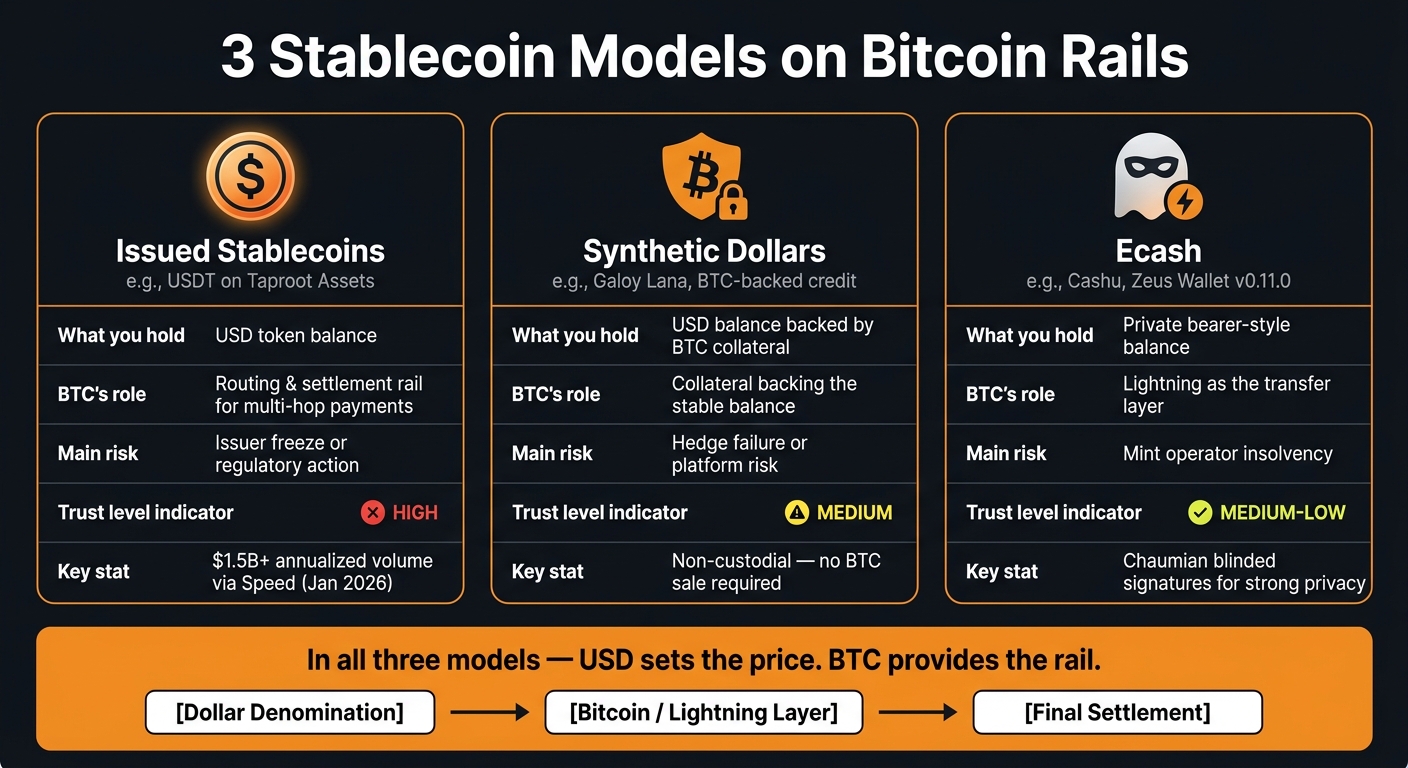
3 Stablecoin Models on Bitcoin Rails: Tradeoffs at a Glance
Bitcoin can carry dollar value without giving up BTC’s role as the base asset. Right now, three main models stand out. Each one makes a different tradeoff around trust, privacy, and the way BTC stays in the middle of the system.
Issued stablecoins on Bitcoin and Lightning: Taproot Assets and RGB
Taproot Assets and RGB let issuers put USDT on Bitcoin rails and move it across the Lightning Network. In February 2025, Tether announced USDT on Taproot Assets. Then, in January 2026, it backed Speed, a merchant payments company built on that system [2][3].
"With Taproot Assets, all multi-hop Lightning transactions route through bitcoin as the global routing currency, making Lightning a decentralized FX layer for stablecoins on bitcoin." [6]
That setup comes with clear tradeoffs. Users still take on issuer risk and need access to redemption. It also depends on steady Lightning liquidity. In practice, that affects how wallets work, how merchants get paid, and how settlement moves from one party to another.
Synthetic dollars backed or hedged with BTC
Some projects take a different path. Instead of issuing a separate token, they let users hold USD balances tied to BTC-backed credit.
Galoy’s Lana platform is a good example. Users lock BTC to get a fiat credit line or hold dollars without selling their bitcoin [7]. On the surface, the user sees dollars. Underneath, BTC is still doing the backing work. The weak point here is platform risk, along with the chance that hedging breaks down.
Ecash and bearer-style balances backed by Lightning
Cashu uses Chaumian blinded signatures, which means the mint can’t link a payment to a specific user. That makes small, repeated payments much easier to use in day-to-day settings. It also fits quick retail transfers and local payments well.
In 2025, Zeus released version 0.11.0 of its self-custodial mobile wallet, which added an experimental Cashu ecash wallet and LN-to-on-chain swaps [6]. The tradeoff is pretty simple: users have to trust the mint operator to stay solvent and honor redemptions.
| Model | BTC’s role | Main trust risk |
|---|---|---|
| Issued (Taproot Assets / RGB) | Routing layer for multi-hop payments | Centralized issuer |
| Synthetic / Hedged | Collateral backing the stable balance | Platform and hedging counterparty |
| Ecash (Cashu) | Lightning as the transfer layer | Mint operator solvency |
These models show up differently inside wallets and payment flows.
Wallets, payment flows, and business use cases
Wallets with BTC and USD balances side by side
Some wallets now show BTC and USD side by side, and each side does a different job. BTC can act as a savings layer. The dollar side helps with day-to-day spending and budgeting because it feels familiar. That matters even more when payments, not just balances, need to feel dollar-based.
The setup depends on the wallet model underneath. In Taproot Assets-enabled wallets like Speed, users can hold USDT balances over Bitcoin and Lightning rails [3]. In swap-based wallets like Breez, users hold BTC until they’re ready to pay, while the app shows a dollar budget view [5].
Roy Sheinfeld, CEO of Breez, put it this way:
"Users continue to hold Bitcoin until the moment they initiate a payment, eliminating the need to maintain separate stablecoin balances." [5]
The app handles the swap flow in the background, so the user mostly sees dollar pricing. Once balance views become simple, the next issue is what happens when those dollars need to settle at checkout.
Merchant settlement, remittances, and dollar pricing
A merchant can accept Bitcoin with a Lightning wallet to price goods in USD and still settle over the network. In August 2025, Steak ‘n Shake rolled out Lightning-only payments across 400 restaurants and reported a 50% reduction in processing fees compared to credit cards [6].
Remittances follow a similar pattern. A sender in the U.S. can hold BTC, enter the recipient’s address, and let the wallet swap BTC into USDC or USDT at transfer time. The sender gets dollar certainty on the amount sent. The recipient gets fast final settlement without waiting days for a bank-style transfer to clear. In both cases, the aim is simple: dollar pricing with Bitcoin-based settlement.
Managing volatility for households and treasury teams
Not every user wants the same kind of exposure. A household may want to leave long-term BTC savings alone while using a dollar balance for groceries and bills. A small-business owner may need payroll in USD without selling BTC at a bad time. A treasury team may want to limit short-term price swings while still keeping BTC on the balance sheet.
Speed Wallet shows how this can work for merchants. Its fees are capped between 0% and 1%, compared to the 2% to 4% often charged by card networks [3]. For treasury teams, non-custodial swap infrastructure like Satora‘s integration with HodlHodl lets operators move between BTC and stablecoins without handing control of funds to a centralized exchange [1].
In that setup, the hedge happens inside the wallet flow, not through a centralized custodian. Each model pushes volatility to a different layer, which is why trust and liquidity risk matter next.
Tradeoffs, risks, and why BTC stays at the center
Trust assumptions: issuer risk, hedging risk, mint risk, and liquidity risk
USD stablecoins on Bitcoin rails don’t replace BTC. What they do is bring dollar pricing, settlement, and liquidity onto Bitcoin-based infrastructure. So the main issue isn’t whether dollars can move on these rails. It’s how much of that system still depends on BTC.
| Model | BTC’s role | Main risk |
|---|---|---|
| Issued (Taproot Assets / RGB) | Routing layer for multi-hop payments | Issuer freeze or regulatory action |
| Synthetic / Hedged | BTC-collateralized backing | Collateral ratio and hedging failure |
| Ecash (Cashu) | Lightning as the transfer layer | Mint insolvency or exit |
That tradeoff matters. The interface may feel dollar-first, but BTC is still doing the hard work underneath as the settlement asset.
Issued stablecoins like USDT and USDC can bring deep liquidity, but there’s a catch: the issuer can freeze balances or face pressure from regulators. Synthetic dollar systems avoid that exact problem, but they take on a different one – collateral management and hedging have to hold up under stress. Ecash-style balances can offer strong privacy and fast transfers, yet users are still trusting the mint operator to stay solvent and keep enough Lightning liquidity available.
Custodial risk isn’t theoretical. More than $2.17 billion was stolen from custodial crypto services in the first half of 2025 [1]. Non-custodial swap systems like atomic swaps remove that custody trust, but they introduce other risks around liquidity, fees, and timeouts [1][4].
U.S. policy, accounting, and compliance considerations
The GENIUS Act gives U.S. businesses a clearer framework for stablecoins, but issuer compliance and accounting rules still affect which rail makes sense. That’s a rail-selection issue, not a change to BTC’s monetary role. Some Lightning payment products now plug into tools like TaxBit to help with tax and accounting compliance [6].
How USD flows can increase demand for BTC liquidity
More dollar-based activity on Lightning can deepen BTC’s role instead of pushing it aside. In the Taproot Assets setup, all multi-hop Lightning transactions route through bitcoin, so stablecoin payments moving across multiple channels still depend on BTC-denominated liquidity [6]. If stablecoin volume rises, the need for well-capitalized BTC routing nodes rises with it [6].
Block‘s Lightning routing node, c=, reported earning a 9.7% annual yield on native, non-custodial bitcoin liquidity in 2025 [6]. BTC also remains the main neutral collateral for non-custodial lending and credit lines. That lets users lock up BTC and get access to fiat liquidity without selling their position [7][4].
USD sets the price. BTC still provides the routing, collateral, and settlement layer. That’s the split that makes Bitcoin rails useful for dollars without pushing BTC into the background.
Conclusion: Stablecoins on Bitcoin rails as a complement to BTC
Stablecoins on Bitcoin rails work alongside BTC. They don’t replace it.
USD denomination helps with pricing, day-to-day spending, remittances, and volatility. Bitcoin and Lightning handle settlement and routing. Put simply: the dollar is the unit of account, while Bitcoin is the rail that moves the payment.
Monthly Lightning Network transaction volume passed $1 billion by late 2025, up from just $12 million in 2021 [5]. In January 2026, Speed processed more than $1.5 billion in annualized payment volume for 1.2 million users using USDT on Lightning through Taproot Assets [3]. At the user level, that kind of scale shows up in a much simpler way: easier wallet flows and fewer headaches at checkout.
That split makes sense in practice:
- Use stable-value tools for payroll, merchant settlement, and remittances
- Hold BTC for savings, self-custody, and final settlement
So the convenience of dollar-based payments doesn’t push BTC aside. If anything, it keeps BTC in the middle of the system.
More dollar-denominated volume on Bitcoin rails also means more BTC liquidity demand at the routing layer. USD sets the unit of account; BTC remains the settlement asset.
FAQs
Do stablecoins on Bitcoin reduce demand for BTC?
No. Stablecoins on Bitcoin are a complementary tool. They expand Bitcoin’s use instead of replacing BTC.
They can drive more network activity and transaction volume. At the same time, they let users keep Bitcoin self-custody while using dollar stability for payments and remittances.
That mix matters. BTC remains the core asset, while stablecoins help with everyday spending, cross-border transfers, and other cases where price stability is a big deal. In practice, this can support Bitcoin infrastructure, liquidity, and payment rails.
Which Bitcoin-based dollar model best fits everyday payments?
For everyday payments, Taproot Assets on the Lightning Network are the best fit. They let people pay with dollar-based stablecoins while merchants receive Bitcoin, all over Lightning.
Think of it as a decentralized foreign exchange layer. Users get price stability. Merchants get the Bitcoin they want. And payments still happen inside the Bitcoin economy instead of pushing users somewhere else.
The result is instant, low-fee settlement with Bitcoin’s security, liquidity, and financial sovereignty.
What is the biggest risk in using USD on Bitcoin rails?
The biggest risk is custody and issuer trust. When people depend on intermediaries to hold USD stablecoins, they’re taking on operational, legal, and security risk.
Using multiple USD stablecoins can also create compatibility and settlement problems. In practice, both sides need to trust the same issuer for the transaction to go through smoothly.
Related Blog Posts
{“@context”:”https://schema.org”,”@type”:”FAQPage”,”mainEntity”:[{“@type”:”Question”,”name”:”Do stablecoins on Bitcoin reduce demand for BTC?”,”acceptedAnswer”:{“@type”:”Answer”,”text”:”No. Stablecoins on Bitcoin are a complementary tool. They expand Bitcoin’s use instead of replacing BTC. They can drive more network activity and transaction volume. At the same time, they let users keep Bitcoin self-custody while using dollar stability for payments and remittances. That mix matters. BTC remains the core asset, while stablecoins help with everyday spending, cross-border transfers, and other cases where price stability is a big deal. In practice, this can support Bitcoin infrastructure, liquidity, and payment rails.”}},{“@type”:”Question”,”name”:”Which Bitcoin-based dollar model best fits everyday payments?”,”acceptedAnswer”:{“@type”:”Answer”,”text”:”For everyday payments, Taproot Assets on the Lightning Network are the best fit. They let people pay with dollar-based stablecoins while merchants receive Bitcoin, all over Lightning. Think of it as a decentralized foreign exchange layer. Users get price stability. Merchants get the Bitcoin they want. And payments still happen inside the Bitcoin economy instead of pushing users somewhere else. The result is instant, low-fee settlement with Bitcoin’s security, liquidity, and financial sovereignty.”}},{“@type”:”Question”,”name”:”What is the biggest risk in using USD on Bitcoin rails?”,”acceptedAnswer”:{“@type”:”Answer”,”text”:”The biggest risk is custody and issuer trust. When people depend on intermediaries to hold USD stablecoins, they’re taking on operational, legal, and security risk. Using multiple USD stablecoins can also create compatibility and settlement problems. In practice, both sides need to trust the same issuer for the transaction to go through smoothly.”}}]}


