This article was originally published on Mi Primer Bitcoin.
At My First Bitcoin, we believe in more than just teaching Bitcoin—we live its principles in every aspect of our organization. Our Bitcoin-Only Policy is a testament to this commitment, ensuring that all saving, spending, and operational activities are aligned with the transformative potential of bitcoin.
We want to lead by example, and an important element of this mission is to be transparent and share our findings with others. This policy is not just a financial choice; it is a bold step toward a future grounded in sovereignty, transparency, and empowerment. 
Disclaimer: this is a report with data about the entire year of 2024, including the policies that were in place in that year.
First: why Bitcoin-Only?
My First Bitcoin is about education, yes. But more than that it is about reimaging what’s possible—then making it real.
We are not trying to build a business; we are trying to change the world. To trailblaze will be more difficult & less certain, but that is the task. Our enemy is not volatility nor inconvenience, it is mission-creep.
More than an education project, My First Bitcoin is a grand experiment to demonstrate a proof-of-concept for an alternative path forward. This is about something so grand that we can talk about forging a new path for humanity’s future—but we lose that if we only ‘talk’ but are afraid to ‘do.’
The best way to predict the future is to create it.
What does Bitcoin-Only mean
Aiming to be Bitcoin-only is quite a statement, and not simple. Looking under the hood, this policy impacts our non-profit in four different way in how we interact with the world:
1. Long-term Savings:
First and foremost, it means that all (!) organizational savings are held in Bitcoin, reinforcing our belief in its long-term value and sovereignty.
2. Operational Expenses:
Our default payment method is Bitcoin. This means that our salaries, rent, supplies, and services are paid primarily in Bitcoin. Besides that, we use Bitcoin-friendly third party services when direct Bitcoin payments are not possible. Finally, fiat payments are strictly a last resort and require continuous efforts to transition to Bitcoin-compatible vendors.
3. Non-Bitcoin Transaction Handling:
We don’t live in a hyperbitcoinized world (yet), and we do interact with companies and individuals living on a fiat standard. This means we need to seek alternatives to non-Bitcoin transactions, and education of parties we interact with is one of them. More on this later.
4. Transparency and Continuous Improvement:
We are funded by our community, by YOU, and not by companies or governments. So we owe you something. We aim to share quarterly reports with the community and donors, but also work on solutions to improve our Bitcoin-only Policy. This includes merchant onboarding (but strictly the ones that we interact with for meetups or services), but also solutions for issues with for example international traveling expenses. More on this later too.
This policy embodies the way we want to see a future: based on decentralized and scarce money, full of empowerment and freedom—not only in education but also in safeguarding the sovereignty of managed donations.
From theory to reality
So how did we do in 2024? Below an analysis of our payment methods in the past year, divided in three categories:
1. Direct Bitcoin payments
2. Payments through third-parties
3. Fiat payments
The best news: In the year of 2024, we noticed a reduction of fiat payments across all quarters, showcasing a clear downward trend in reliance on fiat transactions. In 2024 we paid only 13.56% of our expenses with fiat (based on volumes, not transaction count).
Quarter over quarter, the breakdown comes to the following percentages:
– Q1: 5.8% (of the money we spent in 2024 was a fiat payment initiated in the first quarter)
– Q2: 3.9%
– Q3: 2.0%
– Q4: 2.0%
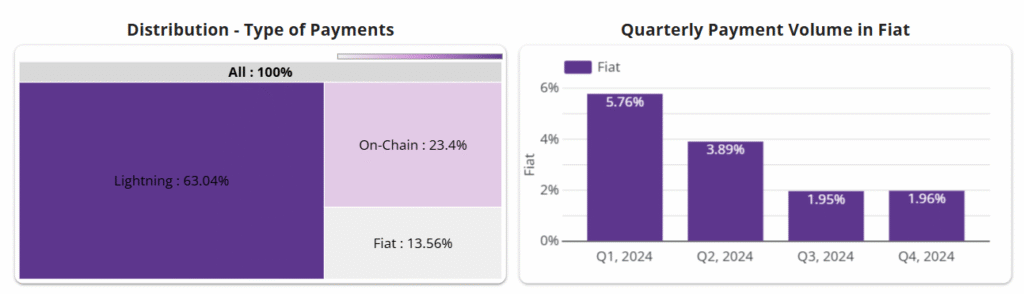
In 2024, My First Bitcoin held 100% of its reserves in Bitcoin, and sent over 85% of its payments volumes using Bitcoin or the Lightning Network. Furthermore, we executed over 800 Bitcoin transactions in 2024.
1. Bitcoin Direct Payments
Overall, the percentage of direct payments, which fosters the circular Bitcoin economy, increased.
Over the past three years, we have continuously documented and expanded the directory of Bitcoin-accepting vendors, besides our efforts to educate stakeholders on the operational benefits of Bitcoin payments.
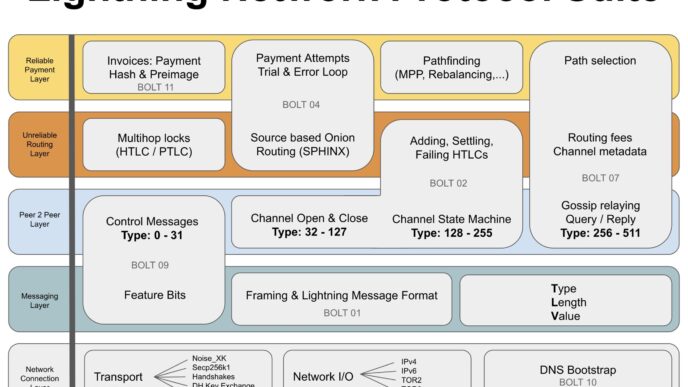
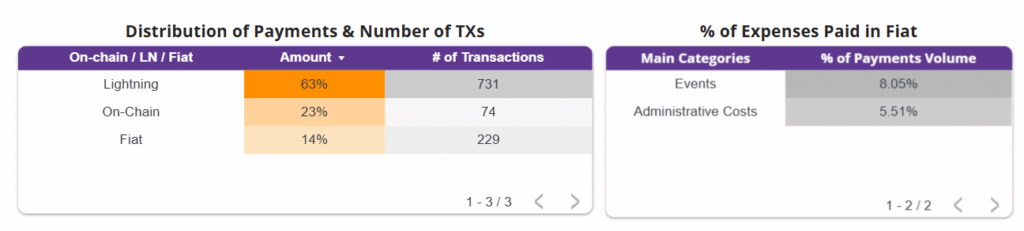
Looking at the volume of the entire year, we used traditional fiat payments for 14% of all of our payments. 63% of all the volume of all payments were sent over the Lightning Network, a secondary layer on top of the Bitcoin blockchain. The remaining 23% of the volume was settled using on-chain transactions.
We notice a growth in our Bitcoin usage, and also an increased adoption of the vendors that we interact with. Hiring new staff members on a Bitcoin standard has not been a bottleneck in our Bitcoin-only policy.
As stated before, our reserves in 2024 were 100% Bitcoin-only.
2. Payments Through Third-Party Services
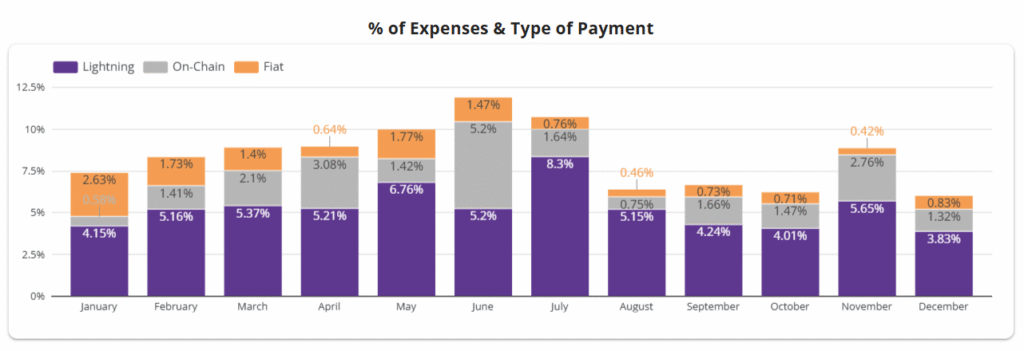
Throughout the year of 2024, we have also used services to use Bitcoin as much as possible. This promotes the collaboration between multiple parties in the ecosystem, with one extra benefit that it’s also often more cost efficient compared to fiat transactions.
Challenges include the dependency on third parties and the higher fees for on-chain payments and crossover applications costs. Of course, education also is a factor in doing these Bitcoin parties, in situations where regular peer-to-peer payments don’t work.
Our recommendations to others implementing the Bitcoin-Only Policy would be to negotiate lower fees for high-volume transactions with the various third parties.
3. Fiat Payments
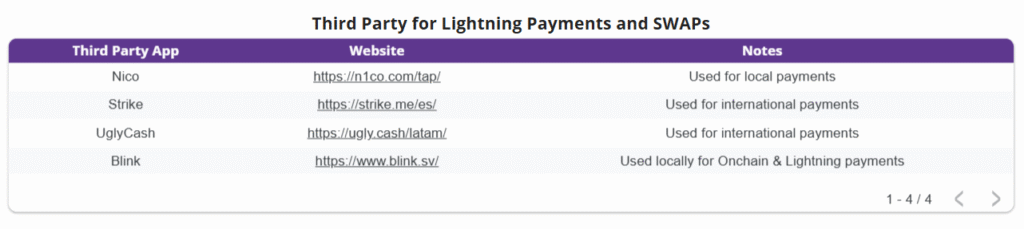
Fiat is still all around us, and we cannot simply ignore that. Our travel expenses (tickets, hotels, and per diem) are significant contributors to fiat usage in our numbers of 2024, it’s by far the biggest subgroup within the percentage of 14%.
Sometimes we also have to make teacher related expenses in rural areas where Bitcoin adoption is still in progress. The other component that causes us to do fiat payments, are recurring subscriptions for tools, for example for graphics editing, video editing and web development software.
Even though we do fiat payments, it’s important to notice that we operated throughout the entire year of 2024 without a bank account: all our fiat payments have been executed via (other) third parties and/or peer to peer swaps with individuals or third parties applications.
We’re proud to see a positive development. The amount of fiat payments have shown a decreasing trend by quarter (Q) in 2024, indicating progress, while the subcategories show where there’s room for improvement with International expenses, teacher expenses, and subscriptions.
Conclusion
Overall, we are proud. Proud for leading the way.
For being an example, and setting a standard for a future that runs on Bitcoin. This includes challenges with travel expenses, and subscription fees, but we’re already proving that it’s possible to run a non-profit for over 85% of the payments and 100% of savings on Bitcoin.
The trend of decreasing reliance on fiat payments is important to maintain and improve.
We continue to pioneer, finding solutions for the remaining ~15% of the volume we still send via fiat payment rails, to decrease that number more quarter by quarter. Education is key, also to realize that.
Besides that, we want to step up our game in terms of monitoring, reporting and transparency, and you can expect more details about our financial situation in 2025, something which we already started doing in 2024 with a breakdown of our funding sources on the Expenses page on our website.
Our Bitcoin-Only Policy reflects our mission to educate and lead by example. By addressing current challenges and leveraging community input, we are committed to advancing toward a fully Bitcoin-driven operational model. Together, we redefine financial systems and embrace the power of decentralized money.